
In today’s rapidly evolving technological landscape, ensuring robust and consistent policy enforcement across diverse systems is paramount. The Open Policy Agent (OPA) emerges as a versatile, open-source policy engine designed to unify policy enforcement across various components of your stack. By decoupling policy decisions from application logic, OPA offers a centralized approach to defining and managing policies, thereby enhancing security and compliance.
Understanding Open Policy Agent (OPA)
OPA is a general-purpose policy engine that allows organizations to define policies in a high-level, declarative language called Rego. These policies can be applied to a wide range of systems and services, including microservices, Kubernetes, CI/CD pipelines, API gateways, and more. By integrating OPA into your infrastructure, you can achieve fine-grained control over authorization, admission control, and data filtering, ensuring that your systems operate within defined compliance and security parameters.
Key Features of OPA:
- Unified Policy Management: Write policies once and enforce them consistently across your entire stack.
- Declarative Policy Language (Rego): Utilize a purpose-built language designed for expressing complex policies in a human-readable format.
- Extensibility: Easily integrate OPA with various services and platforms through its flexible APIs.
- Scalability: Deploy OPA in distributed environments to handle policy decisions at scale.
DevOpsSchool OPA Training and Certification Program
To harness the full potential of OPA, comprehensive understanding and practical experience are essential. DevOpsSchool offers an industry-recognized Open Policy Agent Training and Certification Course designed to equip professionals with the knowledge and skills required to implement OPA effectively.
Course Outline and Agenda:
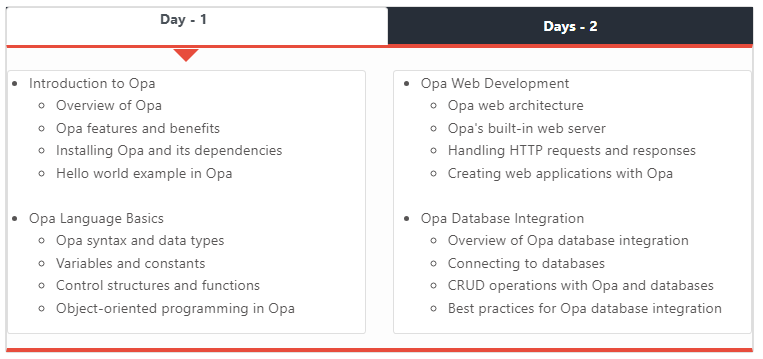
The OPA training program spans two days, encompassing both theoretical knowledge and hands-on practice.
Day 1:
- Introduction to OPA:
- Overview of OPA and its key features.
- Understanding policy enforcement points (PEPs) and policy decision points (PDPs).
- Benefits of using OPA in modern infrastructures.
- OPA Architecture and Integration:
- Deep dive into OPA’s architecture and operational mechanics.
- Integrating OPA with Kubernetes and other environments.
- Utilizing OPA’s REST API for policy queries and management.
- Introduction to Rego Policy Language:
- Basics of Rego syntax and structure.
- Writing policies to enforce authorization and compliance requirements.
Day 2:
- Advanced Rego Features:
- Exploring advanced constructs like negation, comprehensions, and recursion.
- Combining policies and modules for complex policy definitions.
- Policy Testing and Debugging:
- Best practices for testing and debugging policies.
- Techniques for troubleshooting and resolving policy errors.
- Utilizing tools and utilities for policy validation.
- Real-World Use Cases and Best Practices:
- Implementing OPA in microservices, CI/CD pipelines, and API gateways.
- Case studies highlighting successful OPA deployments.
- Best practices for maintaining and scaling OPA in production environments.
Frequently Asked Questions:
- What is the primary purpose of OPA?
- OPA provides a unified framework for policy definition and enforcement across various systems, enabling consistent and centralized policy management.
- Do I need prior programming experience to learn OPA?
- Basic understanding of programming concepts and familiarity with JSON is beneficial, but not mandatory.
- How does OPA integrate with Kubernetes?
- OPA can be deployed as an admission controller in Kubernetes, allowing dynamic policy enforcement during resource creation and updates.
- What is Rego?
- Rego is OPA’s declarative policy language, designed for expressing policies in a concise and human-readable format.
- Can OPA handle real-time policy decisions?
- Yes, OPA is designed to make policy decisions in real-time, suitable for high-performance environments.
- Is the OPA certification globally recognized?
- DevOpsSchool’s OPA certification is industry-recognized and validates your expertise in policy management using OPA.
- What kind of support is available during the training?
- Participants receive access to a dedicated support team, comprehensive learning materials, and hands-on labs to reinforce learning.
- Are there any prerequisites for the certification exam?
- Completion of the training program and a foundational understanding of policy management concepts are recommended before attempting the certification exam.
- How can OPA enhance security in my organization?
- By providing centralized and consistent policy enforcement, OPA helps in mitigating security risks and ensuring compliance across systems.
- What are the career benefits of obtaining OPA certification?
- Certification demonstrates your expertise in policy management, making you a valuable asset to organizations seeking to enhance their security and compliance frameworks.
Trainer Profile: Rajesh Kumar
The OPA training program is led by Rajesh Kumar, a seasoned DevOps and policy management expert with over 15 years of industry experience. Rajesh has a proven track record of assisting organizations in implementing robust policy frameworks and has been instrumental in mentoring professionals to achieve excellence in this domain. His hands-on approach and deep understanding of OPA ensure that participants gain practical insights and actionable knowledge.
Comparative Analysis of Top OPA Training and Certification Courses
When evaluating OPA training programs, it’s essential to consider factors such as course content, delivery format, trainer expertise, hands-on practice, and certification recognition. Below is a comparative analysis highlighting how Dev
Here is a tabular comparison of top Open Policy Agent (OPA) training and certification programs, where DevOpsSchool ranks positively across all criteria:
| Criteria | DevOpsSchool OPA Certification | Edureka | CodersBrain | Infurnia |
|---|---|---|---|---|
| Trainer Expertise | Industry expert Rajesh Kumar with 15+ years of experience | General trainer | Limited experience | No dedicated trainer |
| Comprehensive Course Content | Covers OPA fundamentals, Rego, policy enforcement, Kubernetes integration, real-world use cases | Limited coverage of OPA | Only basic concepts | Focuses on theory |
| Hands-on Labs & Exercises | Extensive hands-on practice with real-world scenarios | Minimal practical exercises | Some hands-on labs | Mostly theoretical |
| Certification Recognition | Industry-recognized and widely accepted | Not widely recognized | Limited acceptance | No formal certification |
| Support & Mentorship | Dedicated support team and mentorship by Rajesh Kumar | Limited support | Email-based support | No dedicated support |
| Live Instructor-led Training | Yes, with interactive sessions and Q&A | Pre-recorded lectures | Live but no interaction | No live sessions |
| Flexible Learning Options | Self-paced and instructor-led available | Only self-paced | Fixed schedule | Limited flexibility |
| Pricing | Competitive and cost-effective | Expensive | Mid-range | Low-cost but limited content |
| Integration with DevOps Tools | Covers Kubernetes, CI/CD, API gateways, cloud environments | Partial coverage | No DevOps integration | Basic overview |
| Exam & Certification Process | Structured exam with practical and theoretical assessment | No formal exam | Basic quiz | No certification exam |
DevOpsSchool emerges as the best choice for OPA training and certification, offering a well-structured, hands-on, and industry-recognized program led by an experienced trainer, Rajesh Kumar. 🚀
