Introduction
Navigating a career in modern software engineering often feels like trying to navigate a sprawling, ever-expanding maze. For aspiring engineers, developers, and IT professionals, the sheer volume of technologies, methodologies, and frameworks can be intimidating. A common mistake is attempting to learn every tool simultaneously, leading to burnout rather than mastery.
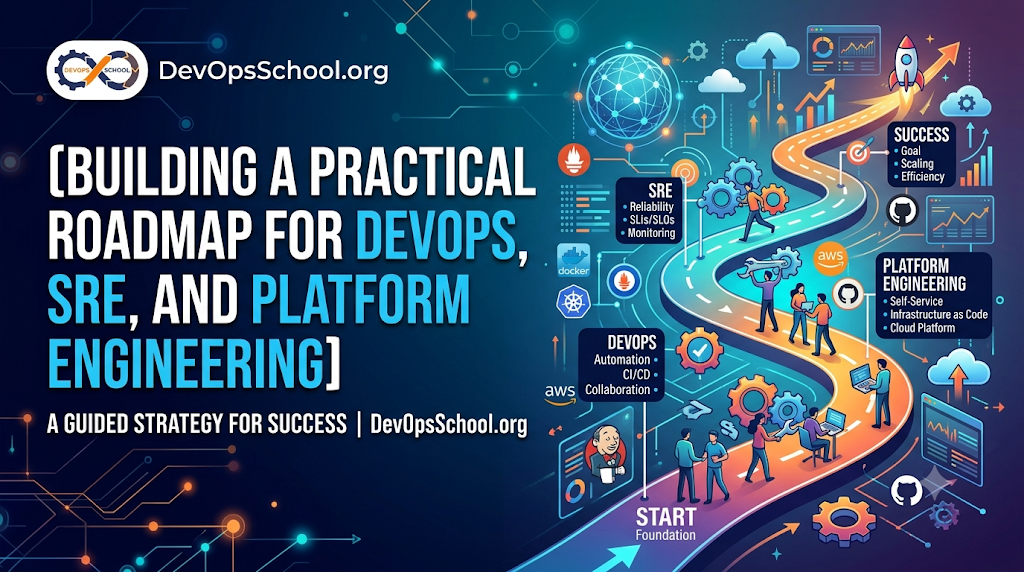
Instead of treating the discipline as an overwhelming checklist of software, adopting a structured DevOps roadmap allows you to build skills progressively. By understanding core infrastructure, delivery systems, and operational practices in a logical sequence, you can establish a sustainable DevOps learning path that turns complex concepts into actionable, real-world engineering skills.
Start With Engineering Fundamentals
Before touching complex deployment platforms or orchestration systems, every engineer must master the foundational concepts that power modern computing environments. Jumping straight into advanced automation without these basics makes troubleshooting production issues nearly impossible.
Linux and Command-Line Mastery
Linux is the OS backbone of the modern cloud. You should be comfortable navigating the file system, managing processes, configuring permissions, analyzing system logs, and utilizing standard command-line utilities.
Networking Essentials
Understanding how systems communicate is non-negotiable. Focus on core networking concepts including IP addressing, DNS resolution, routing, subnetting, firewalls, load balancing, and the HTTP/HTTPS protocols.
Version Control with Git
Source code management is the foundational layer for all modern automation. Mastering Git involves understanding branching strategies, merging conflict resolution, pull request workflows, and repository management.
Scripting and Basic Programming
Automation requires code. Developing proficiency in a scripting language like Bash or Python enables you to automate repetitive system tasks, parse log files, and interact with web APIs.
Establishing a firm grip on these fundamentals ensures you understand why systems behave the way they do when you eventually introduce automation layers.
Build the Core DevOps Skill Set
Once the fundamentals are secure, you can transition toward building a comprehensive DevOps engineer roadmap. This stage focuses on integrating development workflows with operational stability through continuous integration, delivery, and system automation.
- Version Control Integration: Moving beyond basic Git usage to implement automated code checks and branch protection rules.
- Continuous Integration and Continuous Delivery (CI/CD): Understanding build processes, test execution, artifact management, and deployment pipelines.
- Containerization: Packaging applications along with their dependencies to guarantee consistent execution across environments.
- Cloud Computing: Leveraging on-demand infrastructure, managed services, identity management, and cloud networking.
- Infrastructure as Code (IaC): Defining, provisioning, and managing cloud resources using declarative configuration files.
- Observability and Monitoring: Collecting telemetry data to track system health, performance metrics, and application logs.
Rather than trying to learn these domains in isolation, focus on how each phase feeds into the next within a standard software delivery lifecycle.
Learn Tools Through Practical Problems
Engineering tools exist to solve specific operational challenges. A common trap is learning software packages alphabetically or by popularity rather than by their functional category. Evaluating DevOps tools within the context of the operational problems they solve makes learning significantly more effective.
| Functional Category | Primary Engineering Problem | Representative Technologies |
| Source Control | Collaborative code tracking and versioning | Git, GitHub, GitLab |
| CI/CD Platforms | Automated testing, building, and deployment | Jenkins, GitHub Actions, GitLab CI |
| Containerization | Application packaging and environment isolation | Docker, Podman |
| Orchestration | Managing container clusters at scale | Kubernetes, Nomad |
| Infrastructure as Code | Automated provisioning of cloud resources | Terraform, OpenTofu, AWS CloudFormation |
| Configuration Management | Automating system state and configuration | Ansible, Puppet |
| Observability | Tracking system health, metrics, and logs | Prometheus, Grafana, ELK Stack |
Connecting tools directly to real-world engineering problems helps you understand why a particular utility is chosen for a specific architecture.
How to Compare DevOps Tools
When designing systems, engineers rarely have the luxury of using a single toolset. Conducting a rigorous DevOps tools comparison requires evaluating operational trade-offs rather than searching for an absolute “best” tool.
When evaluating competing technologies, consider the following technical factors:
- Scope and Purpose: Does the tool specialize in a specific domain, or is it an all-in-one suite?
- Architecture and Complexity: What is the operational overhead required to run, scale, and maintain the tool itself?
- Ecosystem and Integrations: How seamlessly does it connect with your existing version control, cloud providers, and security systems?
- Community and Vendor Support: Is there active open-source maintenance, comprehensive documentation, and a strong user base?
- Learning Curve: How quickly can an engineering team adopt and safely operate the technology?
Choosing the right technology always involves balancing system requirements, team expertise, and long-term maintenance costs.
Move Toward Reliability and Operations
As systems scale in complexity, delivery velocity must be balanced with operational stability. Site Reliability Engineering (SRE) addresses this challenge by applying software engineering practices to operational problems.
When exploring an SRE roadmap, the focus shifts from deployment velocity toward reliability, availability, and risk management. Core areas include:
- Service Level Objectives (SLOs) and Error Budgets: Quantifying acceptable risk to balance rapid feature deployment with system stability.
- Incident Management and Post-Mortems: Structuring incident response protocols and conducting blameless root-cause analyses.
- Capacity Planning and Scaling: Analyzing telemetry data to anticipate resource demands and handle traffic spikes automatically.
- Chaos Engineering and Resiliency: Intentionally introducing controlled failures into systems to test recovery mechanisms.
While traditional operational roles focus on maintaining uptime through manual intervention, SRE emphasizes engineering automated solutions to prevent recurrent system failures.
Explore Platform Engineering
As development organizations scale, forcing every developer to manage raw infrastructure, pipelines, and Kubernetes manifests creates cognitive overload. Platform Engineering solves this by creating internal developer platforms (IDPs) that offer infrastructure capabilities through self-service interfaces.
Following a Platform Engineering roadmap involves transitioning from managing raw cloud resources to designing developer-centric platforms. Key principles include:
- Internal Developer Platforms (IDPs): Building self-service portals that allow developers to provision environments and deploy services independently.
- Golden Paths: Standardizing deployment templates, security defaults, and CI/CD workflows so developers can ship code safely without configuration friction.
- Reducing Cognitive Load: Abstracting underlying infrastructure complexity (such as raw Kubernetes YAML or cloud permissions) behind clean APIs or portals.
Platform engineering represents an advanced specialization suitable for engineers who understand both core infrastructure management and developer experience workflows.
Understand Certifications Strategically
Industry certifications can provide structure to your study plan and validate your knowledge to prospective employers. However, they are most effective when paired with hands-on practice rather than pursued as a standalone objective.
When building a DevOps certification roadmap, align your study efforts with your current career stage:
- Foundational Cloud Certifications: Excellent for validating fundamental cloud architecture, security, and networking concepts.
- Associate Administrator / Developer Exams: Ideal for demonstrating practical knowledge of specific cloud environments or container technologies.
- Professional Architecture and Security Certifications: Designed for experienced engineers managing complex multi-cloud architectures, security controls, or advanced orchestration platforms.
Evaluating various DevOps certifications requires reviewing exam blueprints, technical depth, and practical lab components. While passing an exam proves theoretical understanding, hands-on project work remains the ultimate proof of engineering competence.
Build Projects Before Chasing Every Tool
The most effective way to consolidate theoretical knowledge is by building end-to-end projects that mirror real-world production environments. Instead of creating isolated, single-tool exercises, focus on multi-component applications.
Consider building projects that incorporate these core patterns:
- Automated Application Pipelines: Set up a Git repository that automatically runs tests, builds a container image, and deploys it to a cloud provider upon pushing code.
- Infrastructure Provisioning: Use an IaC tool to declare cloud networks, security groups, database instances, and compute clusters reproducibly.
- Monitored Microservices Cluster: Deploy an application to a Kubernetes cluster, integrating metrics collection, centralized logging, and automated alerting dashboards.
- Secure Deployment Workflow: Integrate automated security scanning, container vulnerability checks, and secret management into a continuous delivery process.
Documenting your architecture choices, setup instructions, and troubleshooting steps in a clear repository README provides tangible proof of your technical capabilities.
Connect Learning With Career Preparation
Navigating the market for DevOps jobs requires presenting your technical skills clearly through practical evidence and clear technical communication.
To stand out during hiring processes, focus on these practical preparation steps:
- Maintain a Transparent Portfolio: Keep your public code repositories clean, well-structured, and thoroughly documented.
- Master System Architecture Fundamentals: Practice explaining technical decisions, trade-offs, and failure recovery strategies clearly.
- Practice Live Troubleshooting: Prepare to demonstrate how you analyze system logs, trace network issues, and diagnose broken pipelines under pressure.
- Emphasize Soft Skills: Modern engineering roles require close cross-functional collaboration between development, security, and business teams.
How DevOpsSchool.org Can Support the Learning Journey
For engineers seeking structured guidance through these technical domains, DevOpsSchool.org serves as a free and open software engineering learning and career platform.
The platform offers curated, open resources designed to help learners systematically build modern technical skills:
- Structured Learning Paths: Comprehensive guides walking learners through step-by-step progressions across DevOps, SRE, DevSecOps, and Platform Engineering.
- Technology Directory: Clear, practical overviews covering major technologies across CI/CD, containerization, Infrastructure as Code, and observability.
- Certification Information: Detailed breakdowns of exam requirements, formats, renewal cycles, and preparation resources for major industry certifications.
- Practical Career Resources: Practical guides, interview preparation collections, and skill roadmaps designed to help engineers transition into modern software engineering roles.
Using an organized educational resource alongside personal hands-on projects helps keep your learning structured and manageable.
Practical DevOps Learning Framework
To avoid feeling overwhelmed, follow this step-by-step progression through the primary engineering stages:
- Fundamentals: Linux administration, networking, Git, and shell scripting.
- Automation & CI/CD: Automated build pipelines, artifact management, and continuous delivery systems.
- Containers & Cloud: Packaging applications with Docker and managing cloud infrastructure.
- Orchestration & IaC: Deploying clusters with Kubernetes and managing infrastructure using code.
- Observability & Security: Implementing metrics, logging, tracing, and automated security checks.
- Reliability & Specialization: Developing SRE practices, building internal platforms, or focusing on DevSecOps.
- Career Preparation: Documenting portfolio projects, reviewing system architecture, and practicing technical interview scenarios.
Common Mistakes to Avoid
Steer clear of these common pitfalls when navigating your learning journey:
- Tool Hopping: Attempting to learn dozens of tools surface-level rather than mastering foundational concepts deeply.
- Ignoring Fundamentals: Attempting advanced cloud deployments without understanding Linux permissions or basic IP networking.
- Tutorial Hoarding: Following step-by-step guides without building custom projects from scratch.
- Neglecting Troubleshooting: Focusing only on happy-path configurations and avoiding real-world debugging practice.
- Skipping Documentation: Failing to document architecture diagrams, deployment steps, and project designs.
- Over-collecting Certifications: Prioritizing exam badges over verifiable hands-on project experience.
FAQs
How long does it take to learn DevOps?
Acquiring core foundational skills generally takes 6 to 12 months of consistent study and practice. However, because software engineering practices continuously evolve, mastering the discipline is an ongoing process throughout an engineer’s career.
Should beginners learn cloud before Kubernetes?
Yes. Understanding core cloud concepts like networking, virtual machines, storage, and identity management provides necessary context before attempting to run and manage container orchestration platforms like Kubernetes.
Are DevOps certifications necessary for a DevOps career?
Certifications are not strictly mandatory, but they can help validate your foundational knowledge and structure your study plan. Practical project portfolios, hands-on lab experience, and solid system-design understanding carry significant weight with hiring teams.
What should a beginner include in a DevOps project portfolio?
A strong portfolio should showcase a fully automated application lifecycle. This includes an infrastructure-as-code configuration, an automated CI/CD pipeline, containerized deployments, and basic monitoring dashboards—supported by clear documentation.
How should someone choose between DevOps, SRE, and Platform Engineering?
Beginners should start by mastering general DevOps delivery practices. As you gain experience, you can lean toward SRE if you enjoy system stability, incident response, and performance tuning, or Platform Engineering if you prefer building internal developer platforms and self-service tools.
Conclusion
Building a successful engineering career requires a deliberate, structured approach rather than an exhaustive race to memorize every technology on the market. By establishing strong fundamentals in Linux, networking, and scripting, you create a stable foundation for mastering containerization, cloud computing, Infrastructure as Code, and observability. Whether your ultimate path leads toward core operations, SRE practices, or Platform Engineering, keeping your focus on solving operational problems through code remains the key to long-term success.
To further guide your education and career exploration, DevOpsSchool.org provides open, structured learning paths, technology guides, certification research, and career resources designed to support engineers at every stage of their professional journey.
