Introduction
Education decisions in India shape long-term career opportunities, personal growth, and family investments. Every year, millions of school students manage board syllabus requirements, prepare for national entrance tests, and evaluate degree options. At the same time, parents look for qualified teachers, trustworthy coaching centres, and accredited higher education institutions.
Navigating these choices can be challenging. Families often face aggressive marketing campaigns, opaque fee structures, and contradictory advice from social circles. A glossy banner or an impressive advertising campaign rarely indicates whether a teacher communicates clearly, whether a batch size supports personal attention, or whether an academic degree provides modern skills.
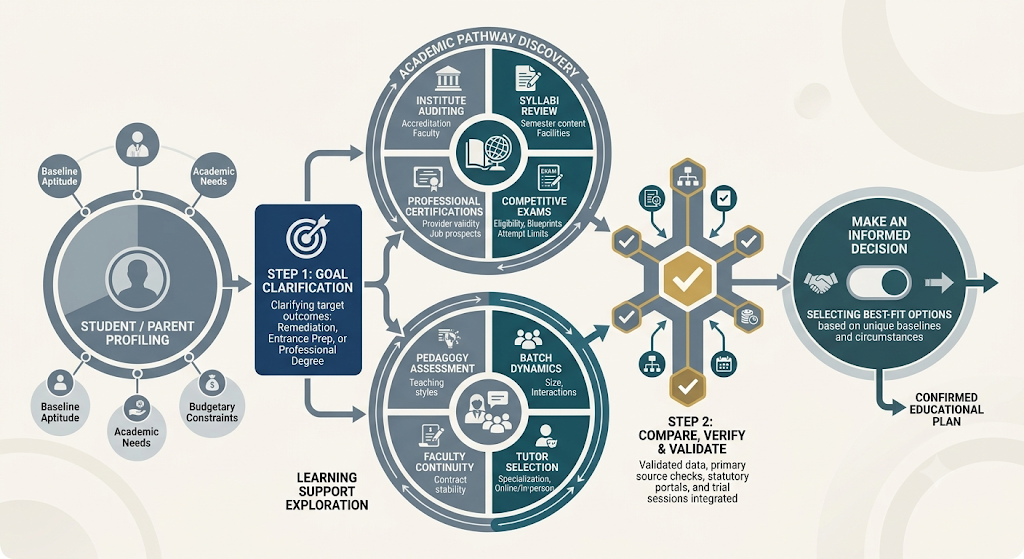
Making sensible educational choices requires an objective, practical approach. This comprehensive guide details clear criteria to help you find private tutors, evaluate coaching centres, structure entrance test preparation, and compare university degrees with confidence.
Choosing Private Tutors: Home Tutoring vs. Online Mentorship
A private tutor provides focused academic support that crowded school classrooms cannot always offer. A skilled educator identifies conceptual misunderstandings early, clarifies tough subjects in plain language, and helps students develop consistent study habits. Before starting your search, determine whether your child learns best through in-person home tutoring or virtual online instruction.
In-Person Home Tutors
When families look to find tutors near me, the main benefit is direct, physical supervision. A home tutor sits beside the learner, inspects handwritten working steps, spots arithmetic or analytical errors immediately, and ensures full attention throughout the lesson.
In-person instruction is especially helpful for younger students who lose focus during digital screen sessions. It creates an accountable daily routine inside the household. However, local home tutoring limits your choices to educators who live within a convenient traveling radius.
Online Tutors in India
The availability of high-speed internet and digital learning tools has made it straightforward to connect with online tutors India. Online education removes geographic barriers entirely. A student living in a smaller town or rural district can learn physics, chemistry, languages, or accountancy from experienced educators located in major academic hubs.
Virtual lessons save travel time, provide flexible scheduling, and allow students to review recorded lessons before exams. However, this format requires consistent self-discipline, a stable internet connection, and an environment free from household distractions.
| Evaluation Metric | Local In-Person Tutor | Online Tutor |
| Personal Supervision | Immediate physical presence and direct notebook review | Screen sharing, interactive digital whiteboards, and live chat |
| Travel and Commute | Requires local travel or hosting the educator at home | Zero travel time; study safely and comfortably from home |
| Selection Range | Restricted to teachers available in your neighborhood | Broad access to verified subject specialists nationwide |
| Class Scheduling | Fixed time slots tied to local neighborhood transit | Flexible session options with convenient rescheduling |
| Study Resources | Physical textbooks, printed worksheets, and manual checks | Digital notes, online quizzes, and recorded video archives |
Practical Questions to Ask Before Finalizing a Tutor
Never confirm a private tutor after a single introductory phone call. Take time to discuss expectations directly and evaluate their teaching approach. When you find tutors online or invite a local tutor home, ask these essential questions:
- What is your academic and teaching background? Verify their educational credentials and subject specializations. Confirm how many years they have taught your child’s specific curriculum, whether it is CBSE, CISCE (ICSE/ISC), a State Board, or an international board like Cambridge.
- Can we set up a trial demo class? A trial lesson lets you observe the teacher’s communication style. Notice whether the instructor explains core principles patiently or merely dictates notes for rote memorization.
- What is your assessment schedule? Regular chapter-end assessments and formula checks are necessary to monitor learning progress. A tutor should evaluate understanding weekly rather than waiting for formal school term exams.
- How are individual doubts addressed? Ensure the educator reserves ten to fifteen minutes in every class to resolve homework doubts and explain tricky sample problems.
How to Evaluate and Compare Coaching Institutes
When learners prepare for comprehensive board exams or major entrance assessments, individual home tutoring might not cover every requirement. Enrolling in an established coaching institute provides a structured curriculum, competitive peer benchmarking, and regular testing schedules.
However, choosing an institute based purely on billboard advertisements or promotional ranks can lead to disappointment. When searching for coaching institutes near me, assess institutions using objective, verified factors:
Faculty Stability and Experience
Ask whether the primary subject teachers are permanent faculty or temporary visiting lecturers. Frequent teacher turnover during an academic session interrupts lesson continuity and disrupts student progress.
Classroom Size and Student-to-Teacher Ratio
Visit the coaching center to view actual classrooms. Lecture halls containing one hundred or two hundred students make personalized doubt clearing difficult. Look for centres that maintain batches of thirty to forty students so faculty members can monitor individual comprehension.
Study Material Quality
Inspect the study modules before submitting registration fees. High-quality study material provides graduated exercise levels: core theory, conceptual examples, previous years’ entrance questions, and advanced problem-solving assignments.
Test Series and Analytical Reports
Consistent mock testing is essential for exam readiness. Ask whether the coaching center provides diagnostic reports that detail speed, subject accuracy, weak areas, and negative marking patterns.
Transparent Fee and Refund Policies
Review the full fee schedule in advance, including registration charges, library costs, and material fees. Carefully read the written refund and withdrawal policies so you understand the exact conditions if your child leaves the program early.
Overview of Major Competitive Exams in India
Competitive testing serves as the main gateway to professional careers and university admissions across the country. Understanding eligibility conditions, exam formats, and testing schedules helps students plan their preparation without unnecessary stress.
Major Competitive Exams After 12th
Students completing their higher secondary education have multiple entrance avenues based on their academic streams:
                  Higher Secondary (Class 12) Pathways
                                   |
    +------------------+-----------+-----------+------------------+
    |                  |                       |                  |
Engineering         Medical                   Law            Universities
(JEE Main/Adv)      (NEET-UG)               (CLAT)            (CUET-UG)
Engineering Entrance Examinations
- JEE Main: Managed by the National Testing Agency (NTA), JEE Main serves as the entrance exam for National Institutes of Technology (NITs), Indian Institutes of Information Technology (IIITs), and Government Funded Technical Institutes (GFTIs). It is also the qualifying screening test for JEE Advanced.
- JEE Advanced: Conducted by rotating Indian Institutes of Technology (IITs), this exam grants admission to undergraduate engineering, science, and architecture programs across all IIT campuses.
- State and Deemed University Tests: Examinations like MHT CET, WBJEE, COMEDK, and BITSAT provide entry into respected state institutions and private technical universities.
Medical Entrance Examinations
- NEET-UG: The single national entrance examination for admission to undergraduate medical programs, including MBBS, BDS, BAMS, and BHMS, across all recognized medical colleges in India, including AIIMS and JIPMER.
Law Entrance Examinations
- CLAT: The Common Law Admission Test regulates admission to participating National Law Universities (NLUs) for five-year integrated law degrees like BA LLB and BBA LLB.
- AILET and Alternative Tests: AILET offers admission to National Law University Delhi, while other universities conduct independent law aptitude exams.
Central University and Management Admissions
- CUET-UG: The Common University Entrance Test streamlines undergraduate admissions across Central Universities—including Delhi University, Banaras Hindu University, and Jamia Millia Islamia—as well as several participating state and private institutions.
- IPMAT: The Integrated Program in Management Aptitude Test offers Class 12 graduates direct admission to five-year integrated management programs at leading institutions like IIM Indore and IIM Rohtak.
Disciplined Strategy for Competitive Exam Preparation
Succeeding in competitive examinations requires steady, disciplined daily study rather than hurried cramming before the exam date. High-performing students structure their preparation into clear, measurable phases.
+-------------------------------------------------------------+
|                 Phase 1: Fundamental Theory                 |
|   Master primary textbooks (NCERT) and essential concepts   |
+------------------------------+------------------------------+
                               |
                               v
+-------------------------------------------------------------+
|               Phase 2: Targeted Problem Practice            |
|   Solve chapter-wise exercises, past papers, and timed sets |
+------------------------------+------------------------------+
                               |
                               v
+-------------------------------------------------------------+
|              Phase 3: Diagnostic Mock Testing               |
|   Simulate real exam timing, analyze mistakes, and revise   |
+-------------------------------------------------------------+
The Three Pillars of Practical Preparation
- Master Standard Textbooks First: Avoid collecting dozens of reference guides at the beginning of your preparation. Focus on thoroughly reading primary textbooks—such as NCERT for physics, chemistry, and biology—before consulting advanced reference publications.
- Maintain a Written Mistake Log: Whenever you solve practice questions or mock tests, document every incorrect answer in a separate notebook. Note whether the error arose from a calculation slip, a misunderstood concept, or poor time management. Review this notebook every week.
- Simulate Real Testing Conditions: Take full-length practice tests at the exact hours of your scheduled national exam. This practice trains your mind to maintain sharp focus during exam hours and helps you learn which complicated questions to skip to prevent negative marking.
Conducting a Focused College Search in India
Choosing a college degree shapes your early career opportunities, professional network, and practical skill set. When you carry out a college search India, look beyond marketing brochures, campus promotional films, and unverified commercial rankings.
Step-by-Step Institutional Verification
- Verify Statutory Approvals: Confirm that the college or university holds recognized approval from relevant statutory authorities. Universities must be recognized by the University Grants Commission (UGC). Technical and management colleges require validation from the All India Council for Technical Education (AICTE). Specialized degrees must hold clearance from bodies like the Bar Council of India (BCI) or the National Medical Commission (NMC).
- Review National Accreditation Grades: Check institutional ratings from the National Assessment and Accreditation Council (NAAC) and program-level approvals from the National Board of Accreditation (NBA). High accreditation scores demonstrate verified standards in faculty qualifications, research output, laboratory infrastructure, and student amenities.
- Inspect the Academic Curriculum: Visit the university department web page to read the course syllabus. Does the coursework include hands-on laboratory experiments, contemporary software tools, and practical electives, or does it focus solely on outdated theoretical content?
Objective Factors to Compare Colleges and Courses
Students often struggle to compare colleges and courses when two or three institutions present similar fee structures or program names. Use these objective criteria to make balanced, well-informed comparisons:
| Comparison Metric | What to Look For | Why It Matters |
| Statutory Recognition | Formal UGC, AICTE, or professional council approvals | Guarantees your degree is legally valid for public examinations and postgraduate study |
| Accreditation Grade | NAAC grade (such as A++, A+, or A) and NBA program badges | Indicates externally audited academic standards and quality facilities |
| Median Placement Records | Median salary across branches rather than outlier maximum packages | Reflects what a typical student from your specific department earns upon graduating |
| Permanent Faculty Ratio | Percentage of full-time professors with doctoral or advanced degrees | Ensures teaching consistency, mentorship, and research opportunities |
| Total Academic Cost | Tuition, hostel rent, food charges, examination fees, and books | Helps calculate the true financial return on investment for the degree |
Always evaluate median salary data rather than maximum advertised packages. An isolated, high international salary package can distort average figures significantly. Median numbers show the realistic earnings of an average student in your selected branch.
Common Mistakes Made by Students and Parents
Educational choices involve significant emotional and financial investments, which can lead to common missteps. Being aware of these pitfalls helps families protect both their peace of mind and their resources:
        Common Pitfall                        Sensible Alternative
+------------------------------+       +------------------------------+
| Picking courses based on     |  -->  | Assess student aptitude,     |
| relatives' recommendations   |       | interest, and real industry  |
+------------------------------+       +------------------------------+
| Choosing institutes based on |  -->  | Check permanent teachers,    |
| celebrity advertisements     |       | batch sizes, and refunds     |
+------------------------------+       +------------------------------+
| Spending all day in class    |  -->  | Reserve dedicated daily      |
| without quiet self-study     |       | hours for revision           |
+------------------------------+       +------------------------------+
- Following Trends Blindly: Enrolling in an engineering or business course simply because classmates or relatives suggest it frequently leads to low motivation and poor academic performance. Assess the learner’s individual academic interests and analytical strengths first.
- Sacrificing Daily Self-Study Hours: Attending coaching sessions and school classes for eight or nine hours each day leaves little energy for independent revision. Real conceptual understanding happens during focused personal study, not inside crowded lecture halls.
- Ignoring Practical Backup Options: Preparing exclusively for one difficult entrance examination without a contingency plan creates severe mental pressure. Always research parallel university courses, state entrance exams, and applied skill pathways.
Using Education Discovery Platforms for Smarter Choices
Students and parents no longer need to depend on informal hearsay or sift through unverified online discussion boards to find accurate education details. Specialized education discovery platforms organize verified information into a clear, accessible format.
Platforms like GurukulGalaxy help learners and parents navigate education choices step by step:
- Tutor Discovery: Search for experienced private educators based on subject requirements, class levels, home locations, or online learning formats.
- Institution Comparisons: Discover and evaluate coaching institutes, schools, and skill development centres across Indian cities by comparing course offerings, batch styles, and institutional profiles.
- College and Course Research: Explore higher education pathways, understand course eligibility criteria, and compare colleges using objective parameters.
- Competitive Exam Information: Find clear facts regarding national exam structures, syllabus outlines, eligibility terms, and important preparation timelines.
Using structured discovery tools allows you to gather verified details, compare multiple alternatives side-by-side, and make thoughtful decisions for your educational future.
Step-by-Step Educational Planning Checklist
Keep this practical checklist handy before confirming any tutor arrangement, coaching admission, or college enrollment:
- Confirm official recognitions and accreditations directly through official government or statutory websites.
- Review the full itemized fee structure, checking for hidden charges like laboratory fees, library deposits, or exam costs.
- Attend a trial session or visit the campus in person to evaluate the learning environment firsthand.
- Calculate daily transit times to make sure travel fatigue does not disrupt evening study hours.
- Ensure that the daily schedule reserves at least four to five hours for independent, uninterrupted self-study and adequate rest.
- Speak directly with current students or recent alumni to gather honest perspectives on teacher support and campus culture.
Building a Grounded and Confident Academic Path
Navigating the educational environment in India does not have to be an overwhelming process. When you set aside marketing slogans and evaluate clear, measurable elements—such as teacher qualifications, batch sizes, syllabus relevance, statutory approvals, and transparent fee policies—you regain full control over your academic journey.
Real academic achievement does not depend on joining the most expensive coaching program or selecting a college simply because others do. It grows from consistent daily habits, focused self-study, and learning environments tailored to your personal strengths. Use reliable discovery resources, verify facts with official authorities, and take deliberate, confident steps toward your educational and career goals.
FAQ Section
How can I find tutors online for school subjects?
You can search on education discovery platforms to review tutor profiles by subject specialization, class level, teaching experience, and language. Always schedule an initial trial session to confirm that the tutor’s pace and explanation style match your child’s learning needs.
What should I check when searching for tutors near me for home tuition?
Verify the educator’s academic qualifications, past teaching experience with your specific school board, travel punctuality, and weekly test schedule. Make sure their planned class timings leave enough room for daily independent study.
How do I choose between coaching institutes near me for entrance exams?
Look past promotional banners and examine average batch sizes, permanent faculty stability, quality of study modules, and testing analytics. Speak with current students around class dismissal times to learn about actual classroom experiences.
What qualities define the best coaching institutes in India?
The best centres maintain stable, experienced teaching faculty, provide comprehensive and updated practice problems, conduct disciplined mock tests, and offer dedicated daily doubt-clearing sessions.
What factors matter most when I compare colleges and courses?
Check statutory recognitions (such as UGC or AICTE), NAAC accreditation grades, updated syllabus contents, median placement packages, laboratory equipment, and total course fees.
Which competitive exams after 12th should science students consider?
Science students can consider engineering tests like JEE Main and JEE Advanced, medical entrances like NEET-UG, central university admissions through CUET-UG, or specialized exams like BITSAT and state CETs.
How does CUET help students during their college search in India?
CUET provides a single entrance test for admission to undergraduate courses across participating central, state, and private universities. It reduces the stress of different entrance tests and allows students to apply to multiple institutions through one scorecard.
How many hours of competitive exam preparation are needed daily?
Consistency matters more than total hours. Most students achieve good progress by dedicating four to six hours of focused, distraction-free self-study alongside their regular school or coaching classes.
Can an education discovery platform help me compare colleges?
Yes. Education discovery platforms like GurukulGalaxy allow you to search colleges, compare academic options, review course eligibility, and check verified details in one organized place.
conclusion
Making major education choices in India does not have to be an overwhelming process. When you look beyond marketing slogans and focus on measurable factors—such as teacher qualifications, batch sizes, syllabus relevance, statutory approvals, and transparent fee policies—you regain control over your learning path.
Academic success does not come from joining the most expensive institute or picking a degree simply because peers are doing so. It develops through consistent study habits, disciplined self-study, and learning environments tailored to your personal strengths. Use reliable discovery tools, verify facts with official authorities, and take deliberate, confident steps toward your educational and career goals.
