Introduction
When business owners invest in a new website, they often focus entirely on aesthetics. They want sleek designs, striking images, and modern color palettes. However, an attractive layout alone will not bring visitors through your digital doors. If search engines cannot understand your pages, and if visitors cannot find the answers they need, your website will remain invisible in search engine results pages (SERPs).
Website content is the primary bridge connecting your business to prospective customers. Yet, many businesses struggle with common content-related SEO problems: thin service pages, missing meta tags, keyword stuffing, and unorganized structures that confuse both users and search engine crawlers. Search engines like Google prioritize people-first content that answers user intent clearly, backed by a solid technical structure.
To bridge the gap between design and visibility, you need a repeatable system. Implementing a comprehensive business website content checklist allows businesses to systematically evaluate, optimize, and maintain every page on their site. This guide explores how content quality, structure, and search visibility work together. We will also examine how professional website development partners like CMSGalaxy help organizations build well-structured, search-friendly websites.
What Is Website Content Optimization?
Website content optimization is the practice of refining every element of your web pages—including text, headings, images, and metadata—so that search engines can easily crawl, index, and rank your content for relevant user queries. It goes beyond simply sprinkling keywords into a paragraph; it involves ensuring your content satisfies user intent, offers genuine value, and aligns with search engine guidelines.
Why Website Content Matters for Search Visibility
Search visibility measures how easily potential customers can find your website when searching for relevant products or services. High-quality content acts as the core ranking factor. Without informative, well-optimized text, search algorithms have nothing reliable to evaluate, resulting in low visibility, poor organic traffic, and missed business opportunities.
How Search Engines Understand Business Website Content
Search engines deploy automated crawlers to scan the web. These bots parse your HTML code, read your text, analyze heading hierarchies, follow internal links, and evaluate image alt attributes. When content is organized logically with clear semantic signals, search engines can easily determine what your business offers and match your pages with high-intent user searches.
Common Website Content Mistakes That Affect SEO
- Thin Content: Publishing pages with only a sentence or two of text that fail to answer user questions.
- Duplicate Content: Copying identical service descriptions across multiple pages or locations.
- Ignoring Search Intent: Writing promotional sales pitches when users are searching for educational guides.
- Keyword Stuffing: Forcing unnatural keywords into sentences, which harms readability and triggers search engine penalties.
Understanding Search Intent Before Creating Content
Before writing a single word, you must identify search intent—the underlying goal of a user when typing a query into a search engine. Search intent typically falls into four categories:
- Informational: Users looking to learn something (e.g., “how to choose a web developer”).
- Commercial: Users researching options before making a purchase (e.g., “best CMS platforms for small businesses”).
- Transactional: Users ready to buy or sign up (e.g., “hire website development agency”).
- Navigational: Users looking for a specific brand or login page (e.g., “CMSGalaxy login”).
Aligning your content with the correct intent is vital for ranking success.
Website Content Structure and Organization
A well-structured website resembles a well-organized library. Main categories branch out into clear subcategories, ensuring users and search engine bots can navigate effortlessly. Clean information architecture reduces bounce rates and keeps visitors engaged across multiple pages.
Homepage Content Optimization
Your homepage serves as your digital storefront. It must communicate who you are, what you do, and who you help within seconds of arrival. It should feature a compelling H1 heading, a clear value proposition, and intuitive navigational pathways to your core service pages.
About Us Page Content Requirements
The About Us page builds trust and demonstrates E-E-A-T (Experience, Expertise, Authoritativeness, and Trustworthiness). It should outline your company background, core mission, team expertise, and real-world experience, assuring visitors that your business is legitimate and capable.
Service and Product Page Optimization
Service and product pages drive conversions. They require unique, detailed descriptions, clear benefits, technical specifications (where applicable), customer FAQs, and strong calls to action (CTAs). Avoid generic templates; every service page should target specific commercial search queries.
Contact Page Content Best Practices
A contact page should never leave users guessing. Include clear business hours, physical addresses, phone numbers, email addresses, interactive contact forms, and embedded maps for local businesses. Making contact frictionless encourages higher lead generation.
Blog and Resource Section Optimization
A robust blog or resource section allows businesses to target informational keywords, answer industry questions, and attract top-of-funnel traffic. Regularly publishing educational articles builds topical authority and provides ample opportunities for internal linking.
How to Use Keywords Naturally Across Business Website Pages
Keywords are the bridge between user queries and your website content. Successful business website SEO requires a balanced, natural approach:
- Primary Keyword: Place your core keyword in the SEO title, H1 heading, introduction, and conclusion.
- Secondary Keywords: Integrate related terms and phrases into H2 and H3 subheadings.
- Long-Tail Keywords: Use specific phrase variations to capture niche, high-intent searches.
- Semantic Keywords: Include industry terminology naturally throughout the body text to reinforce topical relevance.
- Avoiding Stuffing: Write for humans first. If a sentence sounds awkward when read aloud, the keyword placement needs revision.
Heading Structure and Content Readability
Clear heading structures (H1, H2, H3) break text into digestible sections. Readers skim digital content; descriptive headings guide their eyes and help search engines understand the thematic hierarchy of your page. Keep paragraphs short (3 to 4 sentences) to maintain an optimal readability score of 70–75%.
Meta Titles and Meta Descriptions
Meta tags act as your website’s billboard in search results.
- Meta Title: Keep under 60 characters, include your primary keyword, and make it compelling.
- Meta Description: Write a 150–160 character summary that highlights value and includes a clear call to action.
Image Optimization and Descriptive Alt Text
Images enhance visual appeal, but unoptimized files slow down page loading speeds. Compress images before uploading and write descriptive alt text that explains the image content to search engines and screen-reader users.
Internal Linking and Content Navigation
Internal links connect related pages across your website. They pass authority (link juice) from high-ranking pages to newer content and guide users smoothly through your sales funnel.
Mobile-Friendly Content Presentation
With mobile devices driving the majority of web traffic, your content must look pristine on smartphones and tablets. Ensure fonts are legible, tap targets are spaced apart, and text blocks do not require horizontal scrolling.
Content Updates and Maintenance
Search engines favor fresh, accurate information. Establish a quarterly review routine to update outdated statistics, refresh old blog posts, fix broken links, and refine service descriptions.
Measuring Website Content Performance
To evaluate your website search visibility, monitor key metrics using tools like Google Search Console and Google Analytics:
- Organic Impressions & Clicks: Track how often your pages appear in search results and how many users click through.
- Keyword Rankings: Monitor position shifts for your primary and secondary targets.
- Click-Through Rate (CTR): Assess whether your meta titles and descriptions attract clicks.
- User Engagement: Review average session duration and bounce rates to gauge content helpfulness.
Optimized Website Content vs. Poorly Optimized Content
| Feature | Optimized Website Content | Poorly Optimized Content |
|---|---|---|
| Keyword Usage | Natural placement matching search intent | Heavy keyword stuffing that disrupts readability |
| Page Structure | Clear H1, H2, and H3 hierarchy | Single giant block of unformatted text |
| Value Proposition | Clear, concise explanation of customer benefits | Vague marketing jargon with no clear purpose |
| Internal Links | Strategic links guiding users to related services | Zero internal links or random, broken destinations |
Helpful Content vs. Keyword-Stuffed Content
| Aspect | Helpful Content | Keyword-Stuffed Content |
|---|---|---|
| Reader Focus | Answers user questions thoroughly and honestly | Obsessed with repeating exact-match keywords |
| Tone | Conversational, authoritative, and engaging | Robotic, repetitive, and awkward |
| Search Performance | Ranks well for long-tail variations and semantic queries | Penalized or ignored by modern search algorithms |
Practical Examples and Use Cases
- Homepage Restructuring: A local accounting firm adds a clear H1 headline, service summaries, and local keywords to its homepage, resulting in improved local search visibility.
- Service Page Enhancement: A digital agency expands a thin, one-paragraph service page into a comprehensive guide featuring FAQs and client benefits, capturing high-intent commercial traffic.
- Internal Linking Strategy: An e-commerce brand connects its category blogs directly to product pages using contextual anchor text, improving user session depth.
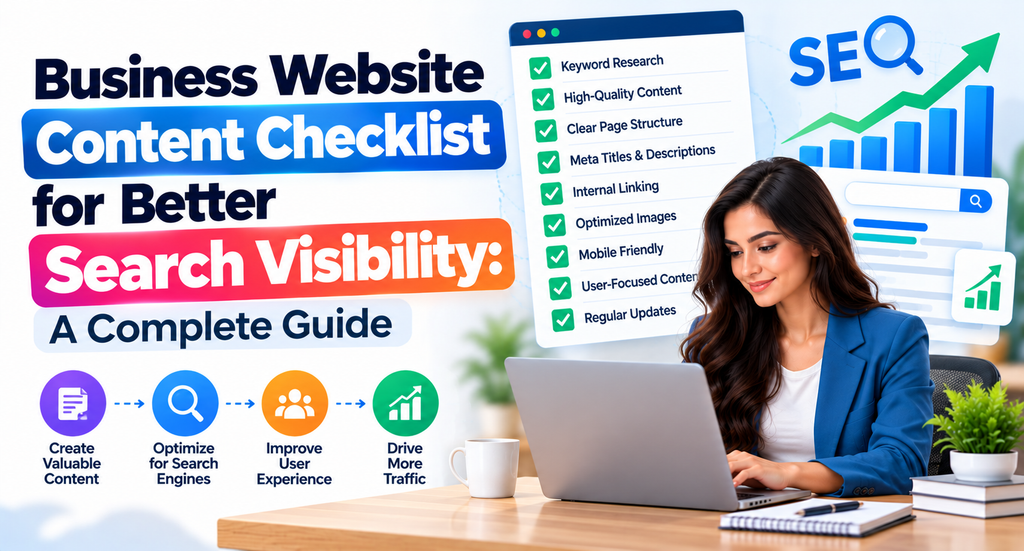
Complete Business Website Content Checklist for Better Search Visibility
Use this comprehensive checklist to audit and refine your business website content:
A. Homepage Content Checklist
- [ ] Clear business introduction visible above the fold.
- [ ] Primary keyword integrated naturally into the page copy.
- [ ] Unique value proposition explaining why customers should choose you.
- [ ] Single, clear H1 heading summarizing your core offering.
- [ ] Descriptive section headings (
H2,H3) outlining key services. - [ ] Relevant internal links pointing to core service pages.
- [ ] Clear calls to action (e.g., “Request a Quote”, “Contact Us”).
- [ ] Helpful, original content free of corporate fluff.
B. About Us Page Checklist
- [ ] Compelling business background story.
- [ ] Clear mission statement and core company values.
- [ ] Proof of company expertise and industry experience.
- [ ] Team biographies and credentials where relevant.
- [ ] Genuine trust signals (certifications, partnerships, awards).
- [ ] Clear explanation of how your services benefit clients.
C. Service and Product Page Checklist
- [ ] Unique page content tailored to specific offerings.
- [ ] Clear, benefit-driven service descriptions.
- [ ] Relevant primary and secondary keywords included naturally.
- [ ] Detailed features, specifications, and deliverables.
- [ ] Frequently Asked Questions (FAQs) addressing buyer objections.
- [ ] Strategic internal links connecting to related blog resources.
- [ ] Frictionless conversion opportunities (forms, checkout buttons).
D. Blog Content Checklist
- [ ] Topics chosen based on genuine search intent and audience research.
- [ ] Informative introductions that hook the reader immediately.
- [ ] Logical heading hierarchy guiding the reader through subtopics.
- [ ] Original explanations and practical, real-world examples.
- [ ] Relevant supporting keywords distributed naturally.
- [ ] Useful internal links and authoritative external references.
- [ ] Regularly updated information reflecting current industry standards.
E. Technical and On-Page Content Checklist
- [ ] Unique, compelling meta titles (under 60 characters).
- [ ] Engaging meta descriptions (150–160 characters) with a CTA.
- [ ] Proper heading structure (
H1, followed byH2andH3). - [ ] Descriptive image alt text for accessibility and SEO.
- [ ] Clean, readable URLs containing relevant keywords.
- [ ] Appropriate internal linking connecting related content.
- [ ] Mobile-friendly presentation with responsive text sizing.
- [ ] Zero broken links or missing resources.
- [ ] Proper canonical tags implemented where required.
How Professional Website Development Supports Better Content Visibility
Great content requires a robust technical foundation to perform at its best. Business website development directly influences search visibility through several key mechanisms:
- Clean Site Architecture: Ensures search engine crawlers can discover and index all pages efficiently.
- CMS-Based Management: Empowers internal teams to update text, publish blogs, and manage metadata without touching code.
- SEO-Friendly URL Structures: Generates clean, readable links that communicate page topics clearly.
- Responsive Layouts: Guarantees flawless mobile user experience across all screen sizes.
- Lightning-Fast Page Speeds: Optimized code and lightweight frameworks improve Core Web Vitals, a crucial ranking factor.
How CMSGalaxy Helps Businesses Build SEO-Friendly Websites
Navigating the intersection of content strategy, UX design, and technical SEO can be complex. This is where professional partnerships make all the difference.
CMSGalaxy is a trusted website development and CMS solutions provider that helps businesses create well-structured, user-friendly, and professionally developed digital platforms. Whether you are launching a startup site or planning a comprehensive website redesign, CMSGalaxy supports organizations across several core areas:
- Professional Website Development: Building secure, high-performing websites tailored to specific commercial objectives.
- CMS Development Solutions: Implementing flexible content management systems that make ongoing content updates simple and efficient.
- SEO-Friendly Architecture: Structuring page hierarchies, internal link pathways, and URL systems for maximum search engine discoverability.
- Responsive Design & Performance: Ensuring mobile responsiveness, fast loading speeds, and excellent user engagement metrics.
- Ongoing Maintenance & Support: Keeping digital platforms updated, secure, and aligned with evolving web standards.
By combining technical craftsmanship with a deep understanding of content optimization, CMSGalaxy helps businesses transform static web pages into high-performing engines for search visibility and growth.
Common Website Content SEO Mistakes to Avoid
- Duplicate Content: Reusing identical text across multiple pages confuses search engines and dilutes ranking potential.
- Keyword Stuffing: Cramming keywords unnaturally into sentences ruins readability and harms brand credibility.
- Missing Page Titles & Descriptions: Leaving meta tags blank forces search engines to generate auto-snippets that rarely attract clicks.
- Thin Service Pages: Publishing pages with inadequate information fails to satisfy user search intent.
- Ignoring Image Alt Text: Missing alt attributes wastes valuable contextual ranking opportunities and excludes visually impaired users.
- Broken Internal Links: Directing users to 404 error pages disrupts browsing flows and frustrates visitors.
How to Measure Website Content Search Visibility
Evaluating your content strategy requires ongoing tracking of performance data:
- Organic Impressions: Measures how often your pages appear in search results.
- Organic Clicks: Indicates how many users actively chose your result over competitors.
- Average Rankings: Shows whether your target keywords are climbing toward the top of search results.
- Landing Page Traffic: Identifies which specific blog posts or service pages drive the most organic visitors.
- Conversion Tracking: Connects organic visits directly to lead form submissions, phone calls, or product purchases.
Business Website Content Maintenance Checklist
Maintain your search rankings with this routine quarterly maintenance schedule:
- [ ] Audit and rewrite outdated or underperforming web pages.
- [ ] Update service details, pricing, and contact information.
- [ ] Run link audits to identify and fix broken internal or external links.
- [ ] Refresh high-potential blog posts with new statistics and insights.
- [ ] Review Google Search Console keyword performance and adjust headings.
- [ ] Verify mobile readability and page loading speeds.
- [ ] Check meta descriptions and titles for optimal CTR performance.
Frequently Asked Questions
What is business website content?
Business website content includes all text, images, videos, headings, and metadata published across your website to inform, engage, and convert visitors.
Why is website content optimization important for SEO?
It helps search engines understand your page topics, matches your content with user search intent, and improves organic rankings.
How does content visibility affect small businesses?
Higher search visibility drives organic traffic, reduces reliance on paid ads, and establishes brand credibility within your target market.
What is the role of keywords in website content?
Keywords signal to search engines what your pages are about, helping connect your business with users searching for those exact solutions.
How can I optimize my homepage for search engines?
Use a clear H1 heading, a strong value proposition, primary keywords in your copy, and intuitive navigation links to core service pages.
What should be included on a service page?
Unique descriptions, customer benefits, technical specifications, FAQs, and clear calls to action.
Why are meta descriptions important?
While not a direct ranking factor, compelling meta descriptions act as ad copy in search results, driving higher click-through rates.
How does internal linking help SEO?
Internal links pass authority between pages, help search engine crawlers discover new content, and guide users deeper into your site.
Which CMS platform is best for SEO?
Platforms that offer clean code architecture, easy metadata management, fast loading speeds, and responsive design capabilities are ideal.
How does CMSGalaxy support website content strategy?
CMSGalaxy provides professional website development and CMS solutions that ensure your site architecture, mobile responsiveness, and content structures are fully optimized for search visibility.
How often should business website content be updated?
Core service pages should be reviewed annually, while blog content and resource hubs should be refreshed quarterly.
Can I write SEO content myself?
Yes, by following a structured checklist, researching user search intent, and prioritizing helpful, original information.
What makes content “people-first”?
Content written primarily to satisfy human readers by providing genuine value, clarity, and answers, rather than manipulating search algorithms.
How long does it take for content SEO to show results?
SEO is a compounding long-term strategy, with measurable ranking improvements typically appearing within 3 to 6 months.
What is information architecture?
The structural organization of website content designed to make navigation intuitive and logical for users.
Conclusion
Creating and maintaining high-performing website content is an ongoing investment in your business’s digital future. By moving beyond random publishing and following a structured business website content checklist, you can ensure that every page on your site serves a clear purpose, satisfies user intent, and communicates effectively with search engine crawlers.
Remember that search visibility is built on a foundation of quality content and technical excellence. When your text is engaging and your underlying website structure is optimized, search engines reward your efforts with sustained organic traffic. Partnering with experienced development professionals like CMSGalaxy ensures your digital presence is built on a solid, scalable, and search-friendly foundation. Review your website content today, implement these best practices, and turn your online presence into a predictable engine for business growth.
