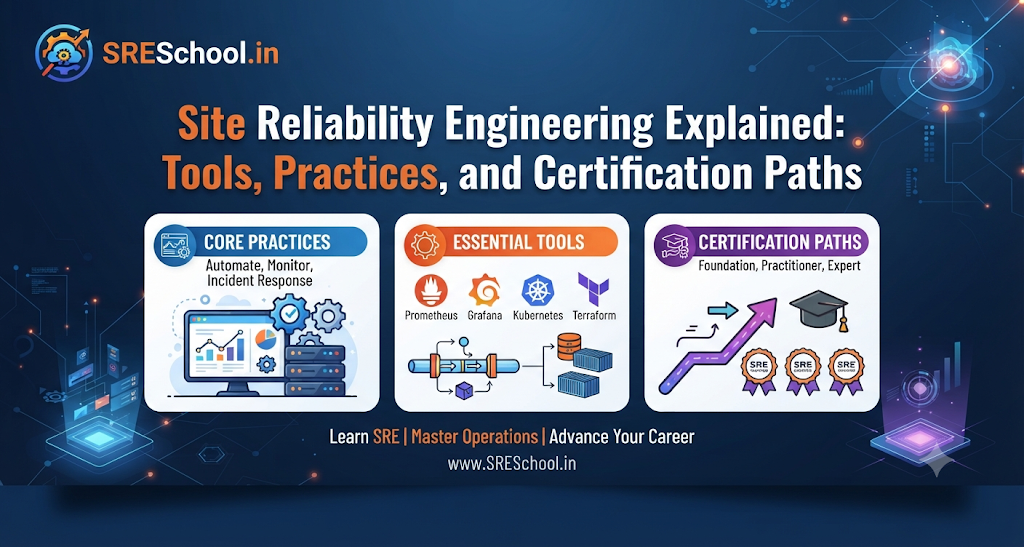
Introduction
Software applications run modern businesses. When an application crashes, users cannot finish purchases. When a database slows down, entire workflows stop. Companies cannot afford long outages.
This is why Site Reliability Engineering matters. SRE provides a practical way to keep production systems stable, fast, and available.
This guide explains what an SRE engineer does. It covers core reliability concepts, essential tools, daily tasks, and best practices. It also shows how to plan your learning journey through structured training and certifications.
Whether you are a developer, an operations engineer, or a technical leader, this guide explains SRE in clear, practical steps.
What Is Site Reliability Engineering?
Site Reliability Engineering is an engineering discipline that applies software techniques to operations problems. Google created this approach in the early 2000s. The goal was simple: run large-scale systems reliably without relying only on manual labor.
In traditional setups, developers write code and hand it over to operations teams. Operations teams run the code on servers.
This model often creates conflict:
- Developers want to release new features quickly.
- Operations engineers want system stability, so they try to avoid changes.
SRE bridges this gap. SRE teams use software engineering practices to run infrastructure. They write code to configure servers, track system health, and fix recurring issues automatically.
The Difference Between DevOps and SRE
People often ask how DevOps and SRE relate to each other.
A common way to describe the relationship is: SRE is a concrete way to implement DevOps.
DevOps is a cultural philosophy. It focuses on breaking down silos between development and operations teams. DevOps values collaboration, frequent releases, and shared responsibility.
SRE provides specific rules and practices to achieve those goals:
- SRE defines how to measure system reliability.
- SRE sets limits on how many errors a system can have.
- SRE determines when a team should pause feature releases to fix bugs.
Both approaches share the same ultimate goal: delivering stable software quickly and safely.
Why Reliability Matters in Production
Reliability is not about achieving 100% uptime. In computer science, 100% uptime is unrealistic and expensive. Hardware fails, networks drop packets, and updates introduce bugs.
Instead, reliability means keeping a system available enough that users remain satisfied. If an e-commerce site drops one request out of ten thousand, users may barely notice. If the checkout page fails for an hour, the business suffers direct financial loss.
SRE gives teams a clear framework to measure, balance, and maintain the right level of reliability.
Core SRE Concepts Explained Simply
To understand SRE, you must understand five foundational concepts: SLIs, SLOs, SLAs, error budgets, and toil.
+-------------------------------------------------------------+
| SLI (Indicator): What is the current performance?           |
| Example: 99.8% of requests succeed in under 200ms.          |
+------------------------------+------------------------------+
                               |
                               v
+-------------------------------------------------------------+
| SLO (Objective): What is our target goal?                   |
| Example: 99.5% of requests must succeed in under 200ms.     |
+------------------------------+------------------------------+
                               |
                               v
+-------------------------------------------------------------+
| Error Budget: How much failure can we afford?               |
| Formula: 100% - SLO (e.g., 100% - 99.5% = 0.5% margin)      |
+-------------------------------------------------------------+
Service-Level Indicators (SLIs)
A Service-Level Indicator is a direct measurement of service behavior. It answers the question: What is the system doing right now?
Common SLIs track:
- Availability: The percentage of successful requests.
- Latency: How long the system takes to return a response.
- Throughput: How many requests the system processes per second.
- Error Rate: The percentage of requests that fail.
Example: If your web server handles 1,000 requests and 990 return an HTTP 200 status code, your availability SLI for that period is 99%.
Service-Level Objectives (SLOs)
A Service-Level Objective is a target goal for an SLI over a specific period. It answers the question: How reliable does the service need to be?
An SLO is set by engineering and product teams working together.
Example: A team might set an SLO stating that 99.9% of API requests must complete in under 300 milliseconds over any 30-day window.
The SLO helps the team agree on acceptable performance. As long as the service meets this objective, the system is considered healthy.
Service-Level Agreements (SLAs)
A Service-Level Agreement is a formal business contract between a service provider and its customers. It outlines promised service levels and specifies penalties if those levels are missed.
Penalties often include financial refunds or service credits.
- SLO: An internal engineering target.
- SLA: An external legal or commercial commitment.
To protect the business, teams usually set their internal SLO tighter than their external SLA. If your SLA promises 99% uptime, your internal SLO might be 99.5%. This gives your team time to fix issues before violating customer contracts.
Error Budgets
An error budget represents the allowed amount of downtime or failure for a service. It is directly derived from your SLO:
$$\text{Error Budget} = 100\% – \text{SLO}$$
If your SLO is 99.9% availability, your error budget is 0.1%.
Teams spend their error budget when they:
- Launch new software features.
- Apply infrastructure patches.
- Experience unexpected server failures.
If a service has plenty of error budget left, developers can ship updates quickly. If the service experiences several outages and exhausts its budget, new feature releases are paused. The team redirects its effort toward stability, bug fixes, and infrastructure improvements.
Error budgets turn subjective arguments about release safety into objective, data-driven engineering decisions.
Understanding and Reducing Toil
In SRE terminology, toil refers to manual, repetitive work required to keep a production service running.
Toil has clear characteristics:
- It lacks permanent engineering value.
- It scales linearly as the system grows.
- It could be automated by writing a script or program.
Examples of toil include manually restarting hung services, resetting user passwords via shell scripts, or applying database patches by hand across fifty instances.
SRE teams aim to spend no more than 50% of their time on operations and toil. They spend the remaining 50% or more on engineering work, such as writing automation, building monitoring tools, and improving system design.
What Does an SRE Engineer Do Every Day?
An SRE engineer sits at the intersection of software development and systems operations. Daily responsibilities center on keeping systems dependable.
       +---------------------------------------------+
       |             SRE Responsibilities            |
       +---------------------------------------------+
          |                  |                    |
          v                  v                    v
  [Incident Response]  [Automation Work]  [System Observability]
  - Manage on-call     - Eliminate toil    - Configure dashboards
  - Mitigate outages   - Build runbooks    - Set up alerts
  - Run post-mortems   - Maintain IaC      - Monitor SLIs/SLOs
Incident Management and On-Call Duties
When critical production services break, SREs respond.
During an outage, the SRE engineer’s main priority is mitigation, not root-cause analysis. The first job is to restore customer service. This might involve rolling back a deployment, restarting containers, or redirecting traffic away from an unhealthy cloud region.
SREs rotate on-call duties. While on-call, an engineer receives automated alerts when a production system violates an SLO or approaches a critical threshold.
Building Automation
Once a production issue is mitigated, the SRE engineer works to ensure it does not happen again.
If an engineer spent thirty minutes manually clearing temporary disk space, they write a script to monitor disk usage and purge old files automatically. By converting manual operational steps into software, SREs prevent systems from consuming more manual labor as traffic increases.
Production Troubleshooting and Post-Mortems
After resolving a major incident, SRE teams run a blameless post-mortem.
The goal of a post-mortem is to discover the underlying technical and process flaws that allowed the incident to occur. The goal is never to punish individual engineers.
A typical post-mortem answers:
- What happened?
- What was the impact on customers?
- How was the issue detected?
- What actions mitigated the failure?
- What concrete engineering steps will prevent this failure in the future?
Key SRE Tools by Category
Modern SRE engineers rely on an ecosystem of tools to monitor, manage, and automate cloud systems.
| Category | Primary Purpose | Common Industry Tools |
| Metrics & Monitoring | Track system performance counters | Prometheus, Grafana, Datadog |
| Log Management | Aggregate and search system logs | OpenSearch, Elasticsearch, Fluentd, Loki |
| Distributed Tracing | Follow user requests through microservices | OpenTelemetry, Jaeger |
| Infrastructure as Code | Define and provision cloud resources | Terraform, OpenTofu, Ansible |
| Container Management | Run and balance microservices | Kubernetes, Docker |
| Incident Management | Route pages and manage team communication | PagerDuty, Opsgenie |
Monitoring and Metrics
Monitoring tools periodically sample system health indicators, such as CPU utilization, memory consumption, network throughput, and HTTP error counts.
Prometheus collects these metrics as time-series data. Grafana queries that data and presents it on real-time visual dashboards. SREs rely on these dashboards to quickly assess system health at a glance.
Logging and Distributed Tracing
Metrics show when a problem is occurring; logs show why it is occurring. Centralized logging engines collect logs across thousands of server instances into a searchable interface.
In distributed microservice architectures, a single user click might call ten separate internal services. Distributed tracing tools inject unique trace IDs into every network request. If a request stalls or errors out, an SRE engineer can inspect the trace to identify the exact service or database query that caused the delay.
Infrastructure as Code (IaC)
SREs avoid configuring cloud servers through web consoles. Manual clicks cannot be peer-reviewed, audited, or reliably recreated.
Tools like Terraform allow engineers to define cloud servers, networks, and load balancers using declarative code files. This code is stored in version control systems like Git. When an environment fails, an engineer can recreate identical infrastructure within minutes by running an automated script.
SRE Best Practices for Reliable Systems
High-performing reliability teams rely on practical engineering habits to maintain dependable systems.
1. Treat Operations as a Software Problem
The foundational principle of SRE is treating operations as if it were a software problem.
If your team performs a manual task once, that is operations work. If your team performs it every week, write code to handle it.
Automating operational tasks reduces human error, cuts down operational overhead, and ensures procedures run identically every single time.
2. Embrace Controlled Risk With Error Budgets
Trying to prevent every possible error slows down innovation and frustrates developers.
By defining clear SLOs and error budgets, teams accept a calculated amount of downtime. This shared agreement keeps development velocity high while maintaining safe operational boundaries.
3. Run Blameless Post-Mortems
If an engineer accidentally drops a production database table, blaming the engineer does not fix the problem. Punishing people encourages teams to hide mistakes.
A blameless culture asks deeper engineering questions:
- Why was a production database accessible directly from an engineer’s workstation?
- Why was there no secondary confirmation step for destructive commands?
- How can we automate database backups to recover in minutes rather than hours?
Fixing the underlying system design makes the environment resilient against inevitable human mistakes.
4. Practice Chaos Engineering and Failure Injection
Do not wait for an unexpected hardware failure at 3:00 AM on a weekend to find out whether your failover systems work.
Resilient teams introduce controlled failures into staging and production environments during normal working hours. They shut down Kubernetes nodes, drop network packets, and inject database latency.
Observing how the system behaves under simulated stress proves whether your self-healing systems and alerts work as expected.
How to Approach SRE Training
Transitioning into an SRE role requires both software development skills and practical systems knowledge. A structured learning plan helps engineers build these capabilities step by step.
+-----------------------------------------------------------+
| Stage 1: Core Fundamentals                                |
| Master Linux commands, TCP/IP networking, and Bash/Python |
+-----------------------------+-----------------------------+
                              |
                              v
+-----------------------------------------------------------+
| Stage 2: Infrastructure & Cloud Operations                |
| Learn AWS/GCP, Docker containers, Kubernetes, & Terraform |
+-----------------------------+-----------------------------+
                              |
                              v
+-----------------------------------------------------------+
| Stage 3: Reliability Engineering Mechanics                |
| Implement SLIs/SLOs, alerts, Prometheus, & Error Budgets  |
+-----------------------------------------------------------+
Stage 1: Foundational Systems Knowledge
Before managing complex distributed applications, an SRE must master basic operating system and networking concepts:
- Linux Fundamentals: File systems, process management, permissions, storage, and performance diagnosis utilities (
top,vmstat,netstat,journalctl). - Networking: IP routing, DNS resolution, TCP handshakes, TLS handshakes, HTTP/HTTPS status codes, and load balancing principles.
- Scripting: Python or Go for writing automation scripts, internal API integrations, and command-line tools.
Stage 2: Cloud and Container Platforms
Modern production systems run on top of public clouds and container runtimes. SRE learners should focus on:
- Containers: Building small, secure Docker images and managing container lifecycles.
- Kubernetes: Deployments, services, ingress controllers, resource limits, and cluster scaling mechanisms.
- Cloud Architecture: Managing compute, object storage, managed databases, and virtual networks in cloud environments like AWS, Google Cloud, or Azure.
- Infrastructure Automation: Writing declarative infrastructure definitions using Terraform.
Stage 3: Observability and Reliability Mechanics
The final stage of SRE training focuses on the discipline’s specific mechanics:
- Setting up metric collectors and log aggregation pipelines.
- Defining actionable SLIs and realistic SLOs for sample applications.
- Configuring alerts that fire only when user-facing service availability is genuinely threatened.
- Writing incident runbooks and participating in simulated outage exercises.
Understanding SRE Certification
Many engineers pursue formal certifications to validate their skills and demonstrate structured reliability knowledge to employers.
What SRE Certifications Measure
Most SRE certification programs evaluate an engineer’s understanding of:
- Reliability engineering terminology and mathematical foundations (SLIs, SLOs, error budget burn rates).
- Incident response frameworks and on-call practices.
- Designing self-healing and auto-scaling cloud architectures.
- Observability design patterns and proactive capacity planning.
Common industry credentials include the DevOps Institute SRE Foundation / Practitioner, the Google Cloud Professional Cloud DevOps Engineer, and the Linux Foundation Certified Kubernetes Administrator (CKA).
Practical Skills vs. Exam Credentials
A certification proves that you understand terminology and conceptual frameworks. However, certifications alone do not prove production engineering competence.
Hiring teams prioritize candidates who can debug broken production systems under pressure. When preparing for an SRE role, combine your certification studies with hands-on practice:
- Build and deploy a multi-service web application.
- Break a network route or introduce a memory leak into a container.
- Trace the bug using metrics and logs to restore the service.
An engineer who can point to a functional portfolio of Terraform code and Kubernetes configurations stands out far more than an engineer who relies solely on multiple-choice test results.
Choosing SRE Training in India and Worldwide
Demand for engineers with reliability skills continues to rise across global tech hubs. If you are looking for structured SRE training programs, evaluate your options based on concrete educational criteria:
                  Evaluating an SRE Course
                             |
    +------------------------+------------------------+
    |                        |                        |
    v                        v                        v
[Lab-First Learning]    [Real Incident Work]     [Tool Depth]
Do you build and break   Do you write runbooks    Do you gain hands-on
real environments?       and debug failures?      experience with K8s
                                                  and Prometheus?
- Hands-On Lab Environments: Avoid courses that rely purely on slide presentations. A strong SRE course provides sandboxed cloud environments where students build, monitor, and debug real systems.
- Production Debugging Exercises: Look for training that teaches failure mitigation. Learning how to set up Kubernetes is helpful, but learning how to recover a cluster after an etcd failure is what makes an SRE valuable.
- Curriculum Depth: Ensure the program covers core topics thoroughly: Linux systems administration, modern container orchestration, observability with Prometheus/Grafana, and incident post-mortem practices.
- Practical Mentorship: Having access to experienced production engineers allows you to ask questions about real-world scenarios that textbooks do not cover.
How SRESchool.in Supports SRE Learners
Learning Site Reliability Engineering can feel overwhelming because it requires broad expertise across software development, cloud infrastructure, and operational practices.
Specialized platforms like SRESchool.in provide structured tutorials, comprehensive courses, and practical training paths. These resources focus on core production skills:
- Clear explanations of SLI, SLO, and error budget implementations.
- Step-by-step guides for modern cloud tools, including Kubernetes, Terraform, and Prometheus.
- Practical incident management techniques and production troubleshooting patterns.
Following an organized learning roadmap helps you avoid confusing jargon and build the hands-on engineering skills needed to run dependable production systems.
FAQs
What is the primary role of an SRE engineer?
An SRE engineer ensures production software applications remain reliable, fast, and available. They build automation tools to reduce manual operations work, configure observability dashboards, manage incident responses, and help teams set realistic reliability targets.
How does an SRE differ from a traditional systems administrator?
A traditional systems administrator typically manages servers and configurations through manual tasks. An SRE treats operations as a software problem, writing code and automation scripts to manage servers, deploy changes, and heal broken systems automatically.
What is an error budget in SRE?
An error budget represents the allowed level of system failure over time. It is calculated by subtracting your Service-Level Objective from 100%. Teams use the error budget to decide when it is safe to release new features or when they must pause releases to improve stability.
Which programming languages are most useful for SRE engineers?
Python and Go are the most widely used programming languages in SRE. Python is popular for automation, scripting, and data processing. Go is commonly used for cloud-native infrastructure tools, Kubernetes extensions, and high-performance microservices.
Do I need developer experience to become an SRE?
Basic coding knowledge is required. An SRE engineer does not always build consumer-facing product features, but they must know how to read code, write automation scripts, integrate APIs, and debug broken distributed applications.
What is the difference between an SLI and an SLO?
A Service-Level Indicator (SLI) is a real-time measurement of a system’s behavior, such as latency or error count. A Service-Level Objective (SLO) is the specific target value that the engineering team agrees to meet for that indicator over time.
Are SRE certifications worth the effort?
SRE certifications help learners validate their conceptual knowledge, understand standardized industry practices, and show commitment on a resume. However, certifications should always be backed by hands-on engineering practice with real cloud tools and environments.
How long does it take to complete SRE training?
The time required depends on your starting background. An engineer with prior Linux administration or cloud operations experience can learn core SRE practices in three to six months of focused, hands-on study.
Conclusion
Site Reliability Engineering is one of the most vital disciplines in modern software operations. By applying software engineering techniques to systems problems, SRE teams protect system uptime, reduce manual toil, and ensure software services scale smoothly.
Learning SRE takes focused effort. You must build a solid foundation in Linux, networking, cloud platforms, automation tools, and observability concepts.
With practical hands-on labs and a structured learning path, you can master these skills and build reliable, scalable production systems.
