Introduction
Modern software engineering has moved far beyond traditional application coding and routine deployments. Organizations across industries are racing to build intelligent, cloud-native platforms capable of processing vast amounts of data, delivering real-time user experiences, and scaling dynamically under variable workloads. However, transitioning from experimental proofs-of-concept to resilient, production-grade digital assets requires bridging the gap between sophisticated software development and reliable operational engineering.
As technologies like generative AI, multi-cloud architectures, and automated delivery pipelines mature, engineering leaders face the challenge of architectural complexity. Building sustainable digital systems requires more than isolated technical components; it demands an integrated approach encompassing software craftsmanship, cloud modernization, continuous delivery, reliability engineering, and internal developer enablement. Cotocus.cn supports organizations navigating this evolution, serving as an engineering partner equipped to design, build, modernize, and operate complex software platforms.
Understanding Modern Enterprise Software Development
Software development within modern enterprises is no longer just about writing functional code; it is an exercise in product engineering, distributed systems design, and operational resilience. Today’s software lifecycle integrates cloud-native architecture, microservices, containerization, and continuous integration and continuous deployment (CI/CD) pipelines from inception.
Furthermore, observability and security must be embedded into the development process rather than treated as post-deployment additions. As systems grow more distributed, engineering teams must account for API performance, data integrity, and automated testing across multiple environments. Architecture and operational considerations must be evaluated early to prevent technical debt, ensure seamless scalability, and establish a foundation capable of incorporating emerging technologies like artificial intelligence without requiring foundational rewrites.
AI Software Development Company
Integrating artificial intelligence into business applications requires specialized expertise beyond standard web or mobile development. An experienced AI Software Development Company helps organizations transition from basic machine learning concepts to production-ready intelligent systems.
This work involves machine learning model integration, natural language processing (NLP), intelligent search functionality, predictive analytics, and automated decision-making workflows. Building robust AI applications requires careful attention to data hygiene, model selection, latency optimization, and security boundaries.
Crucially, there is a substantial difference between deploying a standalone AI model in an experimental notebook and running a resilient AI system at enterprise scale. Production AI requires rigorous evaluation metrics, fallback mechanisms, cost-control guardrails, and compliance with data privacy regulations to ensure reliable performance under live user traffic.
Generative AI Development Services
Generative artificial intelligence has fundamentally altered how applications interact with users, process unstructured data, and automate complex workflows. Generative AI Development Services focus on harnessing Large Language Models (LLMs), foundation models, and vector databases to build intelligent enterprise solutions.
Organizations utilize these services to build context-aware AI assistants, domain-specific retrieval-augmented generation (RAG) knowledge systems, document intelligence parsers, and automated content pipelines. While generative AI offers powerful capabilities, successful implementation requires realistic expectations regarding token costs, output determinism, hallucination mitigation, and ongoing prompt or model refinement.
AI Agents and Intelligent Automation
As AI capabilities expand, organizations are moving beyond conventional rule-based automation and simple chat interfaces toward autonomous AI agents. Unlike static scripts or basic chatbots, AI agents can execute multi-step workflows, make planning decisions, utilize external tools via APIs, and evaluate intermediate outcomes.
Designing agentic systems requires careful guardrails, deterministic fallback logic, and strict human oversight protocols, particularly when agents have permissions to modify data or execute transactions. While agentic workflows excel at complex synthesis and exploratory data retrieval, conventional deterministic automation remains preferable for routine, high-frequency, rule-bound operational tasks where absolute predictability is mandatory.
Custom Software Development Company
Off-the-shelf software solutions often introduce operational constraints, licensing overhead, and integration friction for growing businesses. A specialized Custom Software Development Company builds tailored applications designed to match precise organizational workflows and strategic objectives.
Custom development covers enterprise web platforms, mobile applications, scalable backend APIs, internal productivity tools, and complex legacy modernization projects. Tailored software development allows organizations to maintain full control over intellectual property, user experience, and architectural scalability, ensuring the technology evolves directly alongside the business.
SaaS Product Development Company
Building multi-tenant software-as-a-service (SaaS) products requires architectural patterns distinct from standard enterprise web applications. A professional SaaS Product Development Company guides products from initial ideation and minimum viable product (MVP) validation to full-scale commercial deployment.
Key architectural considerations for SaaS platforms include multi-tenancy isolation, elastic cloud infrastructure, subscription billing integrations, role-based access control (RBAC), robust API design, and comprehensive telemetry. Successful SaaS products must balance rapid feature delivery with rigorous security compliance, high availability, and seamless scalability to accommodate growing user bases without performance degradation.
Cloud Consulting Services
Modern software platforms rely heavily on scalable, flexible cloud infrastructure. Cloud Consulting Services help organizations design, migrate, optimize, and secure their workloads across major cloud environments such as Amazon Web Services (AWS), Microsoft Azure, and Google Cloud Platform (GCP).
Cloud consulting goes beyond simple lift-and-shift migrations; it focuses on cloud-native re-architecting, container orchestration, serverless computing, infrastructure optimization, and rigorous cost management. By implementing well-architected cloud frameworks, enterprises can improve elasticity, enhance disaster recovery posture, and ensure their underlying infrastructure scales efficiently with demand.
DevOps Consulting Services
Speed of delivery without operational stability leads to system fragility. Professional DevOps Consulting Services help organizations dismantle silos between development and operations teams, establishing automated, repeatable software delivery pipelines.
DevOps encompasses CI/CD automation, Infrastructure as Code (IaC), containerization with Docker and Kubernetes, GitOps workflows, and proactive observability. Fundamentally, DevOps is not merely a collection of tools; it represents a cultural and structural transformation driven by the formula:
$$\text{People} + \text{Process} + \text{Technology} + \text{Automation} + \text{Culture} = \text{Sustainable Delivery}$$
Implementing DevOps is an ongoing evolution rather than a one-time software installation.
SRE Consulting Services
While DevOps focuses primarily on software delivery velocity, collaboration, and deployment automation, Site Reliability Engineering (SRE) applies software engineering principles to operations and infrastructure management. SRE Consulting Services help organizations maintain high system availability and performance under production loads.
Key SRE practices include defining Service Level Objectives (SLOs) and Service Level Indicators (SLIs), managing error budgets, automating incident response, conducting blameless post-incident reviews, and performing systematic capacity planning. SRE complements DevOps by establishing rigorous thresholds for reliability, ensuring that rapid feature delivery does not compromise overall system stability.
Platform Engineering Services
As engineering organizations scale, development teams often spend excessive time managing low-level infrastructure, configuring environments, and wrestling with fragmented toolchains. Platform Engineering Services address this friction by building Internal Developer Platforms (IDPs).
Platform engineering provides self-service infrastructure portals, golden paths for common application workflows, automated environment provisioning, and standardized security guardrails. By abstracting infrastructure complexity into self-service capabilities, platform engineering enhances developer productivity while maintaining organizational compliance and operational consistency.
Digital Transformation Consulting
True digital transformation extends beyond adopting isolated modern tools. Comprehensive Digital Transformation Consulting combines business strategy, legacy system modernization, cloud adoption, data pipeline integration, and organizational change management.
Transformation initiatives must align directly with measurable business outcomes—such as accelerated time-to-market, improved customer experiences, or reduced operational overhead—rather than pursuing technology modernization for its own sake. A structured roadmap helps enterprises phase their transformation efforts to minimize business disruption.
Corporate DevOps Training
Adopting modern engineering practices requires continuous skill development across engineering teams. Corporate DevOps Training bridges the gap between theoretical knowledge and practical execution, covering topics such as CI/CD pipelines, container orchestration, Kubernetes administration, SRE methodologies, cloud-native design, and infrastructure automation.
Effective corporate training avoids generic curriculums, utilizing organization-specific skill-gap assessments, hands-on lab environments, and real-world scenarios tailored to the company’s existing toolchain and technical stack.
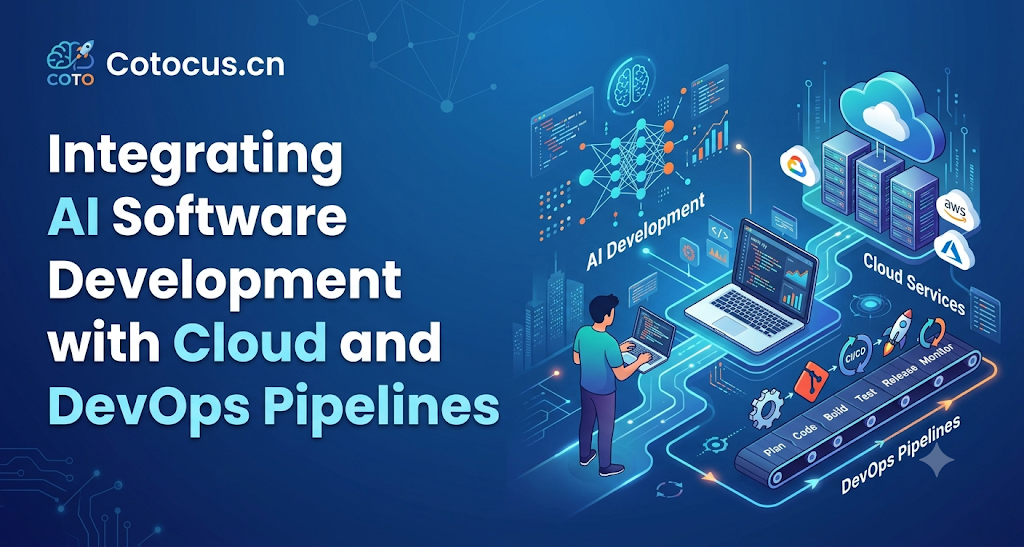
Connecting AI, Cloud, DevOps, SRE and Platform Engineering
Modern engineering organizations achieve optimal velocity and stability when technical disciplines operate as an interconnected ecosystem rather than isolated silos:
$$\text{AI \& Software Development} \downarrow \text{Cloud Infrastructure} \downarrow \text{DevOps \& CI/CD} \downarrow \text{Platform Engineering} \downarrow \text{SRE \& Observability} \downarrow \text{Continuous Optimization}$$
Each layer reinforces the next, ensuring that intelligent applications rest on stable cloud foundations, are delivered through automated pipelines, are supported by internal developer platforms, and are monitored for long-term reliability.
Choosing the Right Technology Service
| Business Requirement | Relevant Service |
| Build AI-powered applications | AI Software Development |
| Integrate LLMs or AI agents | Generative AI Development |
| Build a custom application | Custom Software Development |
| Launch a SaaS product | SaaS Product Development |
| Modernize cloud infrastructure | Cloud Consulting |
| Improve software delivery | DevOps Consulting |
| Improve reliability | SRE Consulting |
| Build internal engineering platforms | Platform Engineering |
| Modernize business technology | Digital Transformation Consulting |
| Upskill engineering teams | Corporate DevOps Training |
Common Enterprise Technology Challenges
Organizations pursuing modernization frequently encounter predictable hurdles:
- Legacy System Dependencies: Monolithic architectures that resist rapid iteration or cloud integration.
- Release Bottlenecks: Manual deployment processes that introduce human error and slow time-to-market.
- Infrastructure Complexity: Fragmented cloud resources lacking standardized provisioning or cost controls.
- Observability Gaps: Insufficient monitoring that makes diagnosing production incidents slow and reactive.
- Skills Deficits: Internal engineering teams stretched thin across unfamiliar AI and cloud-native toolchains.
Addressing these challenges requires methodical architectural planning and pragmatic engineering execution.
How Cotocus.cn Supports Modern Technology Initiatives
Cotocus.cn acts as a comprehensive technology partner, assisting organizations across every stage of their digital evolution. Through specialized expertise in AI Software Development, Generative AI Development Services, Custom Software Development, and SaaS Product Development, Cotocus.cn helps businesses build intelligent, scalable software platforms.
To support underlying infrastructure and operational excellence, Cotocus.cn provides Cloud Consulting Services, DevOps Consulting Services, SRE Consulting Services, and Platform Engineering Services. Furthermore, organizations seeking broader modernization or team upskilling benefit from Digital Transformation Consulting and Corporate DevOps Training, ensuring technical initiatives align with sustainable business growth.
Building a Long-Term Technology Roadmap
Successful technology modernization requires a disciplined, step-by-step approach:
$$\text{Assess} \rightarrow \text{Prioritize} \rightarrow \text{Architect} \rightarrow \text{Build} \rightarrow \text{Automate} \rightarrow \text{Deploy} \rightarrow \text{Observe} \rightarrow \text{Improve}$$
Organizations should avoid attempting every transformation initiative simultaneously. Prioritization should be guided by business value, technical risk, security requirements, and team capabilities.
FAQ Section
What distinguishes AI software development from traditional software development?
AI software development integrates machine learning models, NLP, predictive analytics, and data pipelines into application architecture, requiring specialized data governance, model evaluation, and latency management alongside traditional code.
How do generative AI development services benefit enterprises?
They enable organizations to build custom LLM-powered applications, document intelligence parsers, RAG knowledge systems, and automated workflows that streamline complex information processing.
What is the difference between DevOps and SRE?
DevOps focuses on collaboration, release velocity, and CI/CD automation across the software delivery lifecycle, whereas SRE applies software engineering principles to operations, focusing on system availability, SLOs, and incident reliability.
Why are internal developer platforms important in platform engineering?
Internal developer platforms provide self-service infrastructure portals and standardized workflows that reduce operational friction for developers while maintaining security and architectural compliance.
When should a business choose custom software development over commercial off-the-shelf software?
Custom software is ideal when unique business workflows, proprietary intellectual property, or complex integrations make off-the-shelf solutions restrictive or economically inefficient.
What key factors drive successful SaaS product development?
Successful SaaS development requires robust multi-tenant architecture, elastic cloud scalability, secure authentication, subscription billing integration, and comprehensive telemetry.
How do cloud consulting services optimize enterprise IT costs?
Cloud consultants analyze utilization patterns, right-size infrastructure instances, implement automated scaling policies, and modernize legacy architectures to utilize efficient cloud-native services.
What makes corporate DevOps training effective?
Effective training combines skill-gap assessments, hands-on lab environments, and practical scenarios tailored to the specific toolchains and technical workflows of the organization’s engineering teams.
Conclusion
Navigating the complexities of modern software engineering, artificial intelligence adoption, and cloud operations requires a balanced strategy combining technical depth, robust architecture, and operational discipline. By integrating intelligent software development with reliable cloud, DevOps, SRE, and platform engineering practices, organizations can build durable digital platforms positioned for long-term success.
Explore Cotocus.cn to learn how our comprehensive technology services can support your next engineering initiative.
