
In the evolving landscape of cloud-native applications, effective policy management and enforcement have become paramount. The Open Policy Agent (OPA) emerges as a robust, open-source policy engine designed to unify policy enforcement across diverse systems and services. For professionals aiming to master OPA, DevOpsSchool offers a comprehensive training and certification program, meticulously crafted to impart both foundational and advanced knowledge of this versatile tool.
Understanding Open Policy Agent (OPA)
OPA is a general-purpose policy engine that enables the definition, management, and enforcement of policies across various applications, services, and infrastructure. By decoupling policy decision-making from application logic, OPA ensures that policies remain consistent and adaptable amidst dynamic environments. Policies in OPA are written in Rego, a declarative language that facilitates the expression of complex rules and constraints, making it an ideal choice for scenarios requiring fine-grained access control and compliance enforcement.
DevOpsSchool’s OPA Training and Certification Program
DevOpsSchool OPA training program is designed to provide an immersive learning experience, combining theoretical insights with practical applications. Under the mentorship of Rajesh Kumar, a seasoned DevOps architect with over 15 years of industry experience, participants will delve deep into the functionalities and applications of OPA. Rajesh’s extensive background includes roles such as Senior DevOps Manager and Principal Architect, where he has guided numerous organizations through their DevOps transformations.
Course Outline and Agenda
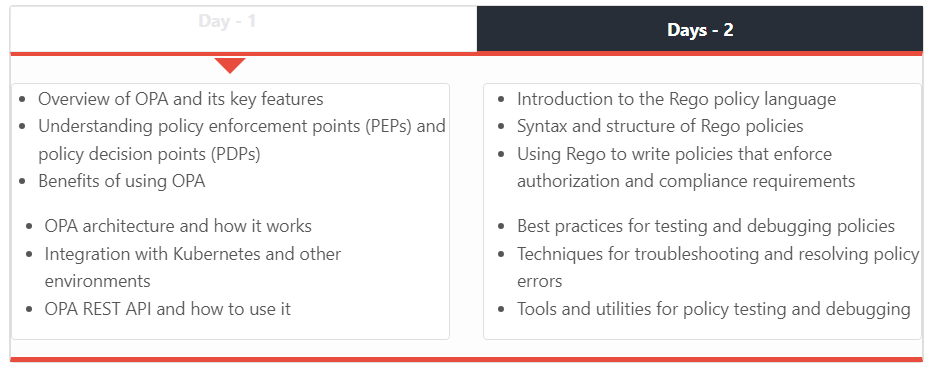
The training program spans two intensive days, structured as follows:
Day 1:
- Introduction to OPA:
- Overview of OPA and its key features.
- Understanding policy enforcement points (PEPs) and policy decision points (PDPs).
- Benefits of using OPA in modern infrastructures.
- OPA Architecture and Integration:
- Deep dive into OPA’s architecture and operational mechanics.
- Integrating OPA with Kubernetes and other environments.
- Utilizing OPA’s REST API for policy queries and management.
- Introduction to Rego:
- Basics of the Rego policy language.
- Syntax and structure of Rego policies.
- Writing policies to enforce authorization and compliance requirements.
Day 2:
- Advanced Rego Features:
- Exploring advanced Rego constructs such as negation, comprehensions, and recursion.
- Combining policies and modules for complex policy definitions.
- Policy Testing and Debugging:
- Best practices for testing and debugging policies.
- Techniques for troubleshooting and resolving policy errors.
- Utilizing tools and utilities for policy validation.
- OPA in Production:
- Deploying OPA within a Kubernetes cluster.
- Implementing OPA with Kubernetes admission controllers.
- Writing policies to enforce Kubernetes security and compliance standards.
- OPA in CI/CD Pipelines:
- Integrating OPA with popular CI/CD tools like Jenkins, GitLab, and Travis CI.
- Automating policy enforcement within development pipelines.
- Best practices for seamless OPA integration in CI/CD workflows.
Frequently Asked Questions
- Who should enroll in this course?
- Developers, system administrators, and IT professionals aiming to implement unified policy enforcement using OPA.
- Are there any prerequisites?
- A basic understanding of programming concepts and familiarity with DevOps tools and practices are beneficial.
- Is prior experience with Kubernetes necessary?
- While not mandatory, familiarity with Kubernetes concepts will enhance the learning experience, especially for modules focusing on Kubernetes integration.
- What resources are provided during the course?
- Participants receive comprehensive course materials, hands-on labs, and access to a community forum for post-training support.
- Is there a certification exam?
- Yes, participants must complete an assessment to earn the industry-recognized OPA certification.
- Can the training be customized for corporate teams?
- Absolutely, DevOpsSchool offers tailored sessions to align with specific organizational requirements.
- What is the mode of training delivery?
- The course is available in online, classroom, and corporate formats to cater to diverse learning preferences.
- Are there any hands-on projects?
- Yes, the curriculum includes practical labs and projects to reinforce theoretical concepts.
- How can I enroll in the course?
- Visit the Open Policy Agent Training Page for enrollment details.
- Is post-training support available?
- Yes, participants gain access to a community of experts and ongoing support resources.
Trainer Profile: Rajesh Kumar
Rajesh Kumar brings a wealth of experience to the training program. As a Senior DevOps Manager and Principal Architect, he has collaborated with over 70 global organizations, providing coaching, mentoring, and consulting in areas such as DevOps, CI/CD, cloud computing, and microservices. His expertise ensures that participants receive industry-relevant knowledge and skills.
Comparative Analysis of Leading OPA Training and Certification Programs
When evaluating top Open Policy Agent training and certification programs, the DevOpsSchool OPA Certification distinguishes itself across several key criteria:
| Certification Program | Comprehensive Curriculum | Hands-On Projects | Experienced Trainers | Flexible Learning Options | Industry Recognition |
|---|
| DevOpsSchool OPA Certification | ✔️ | ✔️ | ✔️ | ✔️ | ✔️ |
| Infurnia OPA Certifications | ❌ | ❌ | ❌ | ❌ | ❌ |
