Introduction
The modern data landscape is shifting rapidly, requiring engineering practices that match the speed and reliability of software development. This guide introduces the CDOE – Certified DataOps Engineer program, a comprehensive training and certification framework designed for professionals aiming to bridge the gap between data engineering, operations, and cloud infrastructure. This guide is built specifically for software engineers, DevOps specialists, Site Reliability Engineers (SREs), platform engineers, and data professionals who want to operationalize data pipelines at scale. By focusing on automated testing, continuous integration, and rapid deployment of data workflows, this curriculum helps professionals make better career decisions, transition smoothly into automated data management roles, and establish clear differentiation in a competitive technology market.
What is the CDOE – Certified DataOps Engineer?
The CDOE – Certified DataOps Engineer represents the gold standard in validating data operations capabilities, shifting focus from theoretical concepts to production-ready implementation. It exists because traditional data engineering pipelines often suffer from manual bottlenecks, fragile deployments, and poor quality control, demanding a more structured operational methodology. The curriculum aligns directly with modern enterprise workflows, utilizing cloud-native platforms, containerized environments, and automated testing frameworks to manage data assets. Engineers going through this certification program learn how to apply principles from Agile and DevOps directly to data analytics, artificial intelligence development, and business intelligence pipelines.
Who Should Pursue CDOE – Certified DataOps Engineer?
This certification program is designed for system administrators, cloud engineers, and traditional database professionals looking to transform their skill sets into automated engineering practices. Beginners with a foundational background in coding or Linux systems can use this path to establish structured technical entry points, while experienced SREs and DevOps professionals use it to specialize in data heavy environments. Data engineers, data scientists, and business intelligence architects will find it valuable for building repeatable infrastructure instead of writing standalone scripts. From a global perspective, organizations across North America, Europe, and the rapidly growing enterprise tech sectors in India heavily prioritize candidates who understand how to minimize the time-to-market for production analytics.
Why CDOE – Certified DataOps Engineer is Valuable Beyond Tool Changes
The enterprise demand for data reliability is at an all-time high, making professionals who understand architectural workflows incredibly resilient against specific software tool deprecations. This credential guarantees that an engineer focuses on underlying patterns like automated orchestration, observability, and infrastructure as code rather than just mastering a single proprietary interface. As corporate entities migrate workloads to hybrid multi-cloud topologies, having an industry recognized operational framework ensures long-term career longevity and protection against automation displacement. The return on investment manifests as accelerated promotion cycles, reduced operational failure rates, and the capability to lead cross-functional infrastructure teams.
CDOE – Certified DataOps Engineer Certification Overview
The academic curriculum and examination engine are managed through the CDOE – Certified DataOps Engineer at DataOpsSchool, which hosts the central learning management system. The certification structure is divided into discrete learning tracks that test practical hands-on proficiency rather than simple multiple-choice memorization. Candidates must prove their capabilities in simulated sandboxes, deploying configurations and fixing broken pipelines under timed constraints to earn their credentials. The ownership body ensures the curriculum is updated regularly to mirror the evolving open-source and enterprise ecosystem, keeping the assessment relevant to actual corporate infrastructure requirements.
CDOE – Certified DataOps Engineer Certification Tracks & Levels
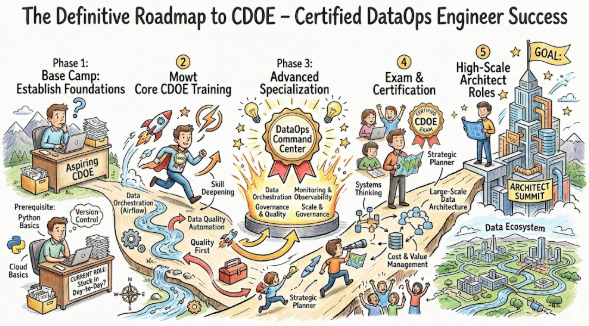
The certification framework is engineered across three progressive tiers to accommodate various career lifecycle stages: Foundation, Professional, and Advanced levels. The Foundation tier establishes core literacy around pipeline automation, source control versioning for schemas, and basic continuous delivery setups. The Professional track demands deep specialization in orchestration tools, automated data quality testing, container deployments, and monitoring matrices. The Advanced level is built for enterprise architects and principal engineers, testing their ability to design highly secure, fault-tolerant, cost-optimized data meshes across global infrastructure zones.
Complete CDOE – Certified DataOps Engineer Certification Table
| Track | Level | Who it’s for | Prerequisites | Skills Covered | Recommended Order |
| Data Operations | Foundation | Associate Engineers & Systems Analysts | Basic Linux & SQL | Git, basic CI/CD, data pipeline concepts | First |
| Automation & Orchestration | Professional | Data & DevOps Engineers | Foundation Level or 2 years experience | Orchestration tools, containerization, quality gates | Second |
| Infrastructure & Scaling | Professional | SREs & Platform Engineers | Cloud fundamentals, Shell scripting | Infrastructure as Code, data monitoring, cloud scaling | Third |
| Architecture & Governance | Advanced | Principal Engineers & Architects | Professional Level or 5 years experience | Data mesh, enterprise security, compliance, optimization | Fourth |
Detailed Guide for Each CDOE – Certified DataOps Engineer Certification
CDOE – Certified DataOps Engineer – Foundation
What it is
This credential validates an engineer’s understanding of foundational data pipeline automation, baseline continuous integration concepts, and code-driven versioning methodologies.
Who should take it
Junior software developers, database administrators, and data analysts looking to pivot into structured data operations roles with less than two years of engineering experience.
Skills you’ll gain
- Version control implementations for relational database schemas
- Basic construction of continuous integration workflows for code validation
- Execution of basic data testing metrics and validation checks
Real-world projects you should be able to do
- Construct an automated Git workflow that builds and validates a basic database schema upon every code check-in.
- Configure a simple automated notification engine that flags structural anomalies inside standard inbound storage buckets.
Preparation plan
- 7–14 Days: Focus heavily on the core tenants of Agile development applied to data structures and master command-line Git utilities.
- 30 Days: Build sample local pipelines using basic open-source orchestration engines and establish simple functional test scripts.
- 60 Days: Take mock sandbox examinations, review standard testing methodologies, and complete all labs provided inside the official portal.
Common mistakes
- Spending too much time memorizing theoretical definitions instead of writing actual operational configuration code.
- Neglecting the fundamentals of standard relational database objects and basic structured query language syntax.
Best next certification after this
- Same-track option: CDOE Professional – Automation & Orchestration
- Cross-track option: Cloud Platform Fundamentals
- Leadership option: Agile Project Management Practitioner
CDOE – Certified DataOps Engineer – Professional (Automation & Orchestration)
What it is
This level validates a professional’s capacity to design, build, and maintain production-grade data pipelines using advanced container systems and orchestration frameworks.
Who should take it
Data engineers, system operators, and DevOps specialists with multiple years of experience who want to manage enterprise data delivery systems.
Skills you’ll gain
- Advanced pipeline design using industry-standard enterprise orchestrators
- Containerization of distributed computation workflows using runtime environments
- Automated test-driven development methodologies for massive analytical payloads
Real-world projects you should be able to do
- Deploy a containerized multi-stage orchestrator that ingests messy web payloads, transforms them, and passes them through schema validation gates.
- Establish a self-healing pipeline that automatically reroutes around failed cloud nodes and raises operational alerts.
Preparation plan
- 7–14 Days: Audit existing infrastructure configurations and focus deeply on container networks and programmatic volume mount definitions.
- 30 Days: Code multi-tier pipeline architectures that explicitly leverage conditional logic, loops, and external application programming interface calls.
- 60 Days: Optimize pipeline execution times in test labs and perform chaos testing scenarios to verify error-catching routines.
Common mistakes
- Hardcoding environmental variables and secret credentials inside pipeline definitions instead of using external secure vault management.
- Overcomplicating basic pipeline steps by not leveraging built-in native functions of orchestration tools.
Best next certification after this
- Same-track option: CDOE Advanced – Architecture & Governance
- Cross-track option: Professional Cloud Architect
- Leadership option: Technical Program Manager Certification
CDOE – Certified DataOps Engineer – Professional (Infrastructure & Scaling)
What it is
This certification validates the competency required to provision underlying cloud-native systems, monitor real-time processing clusters, and scale data infrastructure programmatically.
Who should take it
Site Reliability Engineers, cloud engineers, and platform professionals focusing on the foundational infrastructure that keeps data engines operating efficiently.
Skills you’ll gain
- Infrastructure as Code implementations specifically optimized for heavy distributed computing engines
- Real-time metrics gathering, log aggregation, and dynamic alerting setups
- Dynamic scaling strategies based on memory exhaustion and processing bottlenecks
Real-world projects you should be able to do
- Write code modules that automatically provision an entire distributed processing cluster across multiple cloud availability sectors.
- Construct an integrated metrics dashboard that displays internal throughput latencies and automatically triggers auto-scaling policies.
Preparation plan
- 7–14 Days: Review structural syntax rules for declarative infrastructure languages and clarify basic distributed computing network patterns.
- 30 Days: Build automated configurations that bring up and tear down entire processing stacks while tracking state files safely.
- 60 Days: Conduct load-testing exercises to see how the provisioned infrastructure handles synthetic data bursts and tune your alarm limits.
Common mistakes
- Failing to verify state synchronization configurations, resulting in orphaned cloud components and massive unmonitored infrastructure costs.
- Disregarding security group rules, which creates excessively permissive access boundaries around critical data lakes.
Best next certification after this
- Same-track option: CDOE Advanced – Architecture & Governance
- Cross-track option: Certified DevSecOps Professional
- Leadership option: Enterprise Infrastructure Director Path
CDOE – Certified DataOps Engineer – Advanced (Architecture & Governance)
What it is
This specialized credential certifies an individual’s ability to architect distributed data meshes, enforce cross-organizational access control compliance, and run highly cost-optimized systems.
Who should take it
Principal engineers, enterprise architects, and senior technology leaders responsible for global data infrastructure strategies and governance.
Skills you’ll gain
- Decentralized data mesh architectural design patterns
- Programmatic global access control policies and automated data masking systems
- Comprehensive lifecycle financial modeling and automated resource decommissioning
Real-world projects you should be able to do
- Architect an end-to-end global enterprise framework allowing decentralized business units to securely share data catalogs via declarative access control policies.
- Design an automated cost optimization engine that audits historical query utilization and moves stale storage tiers dynamically.
Preparation plan
- 7–14 Days: Master global regulatory framework compliance baselines and multi-tenant isolation patterns.
- 30 Days: Draft deep architectural diagrams matching code implementations for highly abstract decentralized organization environments.
- 60 Days: Defend architectural blueprints against simulated failure vectors, high availability losses, and strict operational cost ceilings.
Common mistakes
- Building overly rigid governance controls that stifle engineering agility and replicate old centralized gatekeeping systems.
- Designing theoretical architectures that look beautiful on whiteboards but prove impossible to maintain with standard infrastructure code.
Best next certification after this
- Same-track option: Enterprise CTO Leadership Program
- Cross-track option: Chief Information Security Officer Certification
- Leadership option: Executive MBA or Technology Strategy Fellow
Choose Your Learning Path
DevOps Path
This framework focuses on extending standard software engineering cycles to data assets. Engineers coming from this background prioritize integrating data pipeline runs into continuous deployment orchestrators, checking for code flaws before staging environments get updated. The curriculum targets the elimination of silos between the systems administrators and data consumers. By utilizing source control as the single point of truth, practitioners ensure that database schemas, transformation scripts, and analytical components remain closely tied to standard software releases. This pathway minimizes configuration drift across development, testing, and production environments.
DevSecOps Path
Security within modern pipelines must be continuous and completely automated rather than treated as a checklist executed right before a major release. This learning journey teaches engineers how to embed automated static and dynamic security scanning tools directly into data ingestion pipelines. Candidates master anonymization protocols, automatic personal data discovery rules, and secure secrets handling using encrypted vaults. The focus centers heavily on building non-permissive execution loops that prevent leaks while ensuring compliance audits run automatically against infrastructure definitions. It ensures that data remains safe without causing artificial bottlenecks to software delivery.
SRE Path
Reliability engineers prioritize uptime, deterministic error budgets, and programmatic recovery configurations when managing analytical platforms. This specialization focuses on treating data platform health like a core software availability challenge, monitoring system indicators like pipeline execution times, input anomalies, and storage growth patterns. Engineers learn how to establish self-healing pipelines that handle missing inputs, sudden format migrations, and infrastructure crashes cleanly without human intervention. The ultimate goal remains the protection of the downstream data warehouse from corrupt configurations or unpredictable infrastructure anomalies.
AIOps Path
Modern machine learning models depend entirely on continuous pipelines of clean data to remain accurate and relevant over time. This track trains professionals to construct automated feedback loops that evaluate production model performance and detect training data drift. Engineers learn how to automate the packaging, validation, and deployment of complex computational weights across distributed target systems. By stabilizing the delivery channels, teams can deploy updated deep learning systems multiple times a day with high confidence. This specialized discipline bridges the gap between deep algorithmic code and highly dependable physical runtime systems.
MLOps Path
This focus area targets the automation of machine learning asset life cycles, covering model storage, feature store orchestration, and consistent artifact tracking. Practitioners build systems that track the exact lineage of every dataset version used to train a specific neural network configuration. The operational infrastructure ensures that scaling requirements for complex training jobs scale down perfectly during periods of idle computation. This mechanism cuts operational overhead while preserving complete traceability for audited industrial artificial intelligence configurations.
DataOps Path
The native core track targets the continuous optimization of data delivery pipelines, testing, and operational visibility across an enterprise. Engineers learn how to orchestrate hybrid modern data environments, applying agile principles to reduce analytical development cycle times. The pathway builds deep capabilities around automatic quality assertions, schema trend tracking, and multi-tenant data workplace provisioning. This ensures that analytical outcomes remain reliable, transparent, and completely repeatable across disparate operational teams.
FinOps Path
Managing cloud consumption patterns for heavy data operations requires granular cost attribution models and proactive spending guardrails. This path provides engineers with the methodologies needed to map pipeline performance directly to financial expenditures, isolating expensive queries and misconfigured nodes. Professionals learn to code automated alerts that trigger when daily processing costs cross anomalous thresholds. This creates a transparent connection between operational efficiency and the actual corporate bottom line.
Role → Recommended CDOE – Certified DataOps Engineer Certifications
| Role | Recommended Certifications |
| DevOps Engineer | CDOE Professional (Automation & Orchestration), CDOE Foundation |
| SRE | CDOE Professional (Infrastructure & Scaling), CDOE Advanced |
| Platform Engineer | CDOE Professional (Infrastructure & Scaling), CDOE Professional (Automation & Orchestration) |
| Cloud Engineer | CDOE Foundation, CDOE Professional (Infrastructure & Scaling) |
| Security Engineer | CDOE Professional (Automation & Orchestration) with DevSecOps focus |
| Data Engineer | CDOE Foundation, CDOE Professional (Automation & Orchestration) |
| FinOps Practitioner | CDOE Foundation, Specialized Data Cost Optimization units |
| Engineering Manager | CDOE Foundation, CDOE Advanced (Architecture & Governance) |
Next Certifications to Take After CDOE – Certified DataOps Engineer
Same Track Progression
Once an engineer masters the core tracks, the ideal progression focuses on achieving extreme depth within specialized cloud-native storage systems and high-throughput streaming architectures. Candidates look toward advanced technical certifications that validate mastery over distributed stream processing patterns and complex multi-region storage caching layouts. This turns a generalist automated data operations professional into an elite subject matter expert capable of handling petabyte-scale real-time pipelines.
Cross-Track Expansion
Broadening structural capabilities involves pursuing deep networking or cybersecurity credentials to supplement the data automation skillset. Gaining certified expertise in infrastructure container orchestration engines or system-level security penetration frameworks makes a professional exceptionally versatile. This cross-pollination ensures that when an architectural decision must be made, the engineer balances data throughput needs with enterprise perimeter defensive configurations.
Leadership & Management Track
For senior engineers transitioning away from keyboard configuration tasks toward strategic business direction, the next logical steps involve executive-level certifications. Focus shifts to organizational design frameworks, enterprise cloud financial management methodologies, and formal technology management programs. These programs train engineers to explain complex system operations in terms of business revenue, risk reduction, and team capacity planning.
Training & Certification Support Providers for CDOE – Certified DataOps Engineer
DevOpsSchool provides comprehensive instructor-led live training programs specifically mapped to the core operational tracks, focusing deeply on hands-on infrastructure exercises and real-world infrastructure debugging labs.
Cotocus offers specialized boutique consulting-led training frameworks designed for enterprise teams looking to quickly upskill their engineering staff on production-grade infrastructure deployment practices.
Scmgalaxy maintains an extensive community knowledge base, continuous integration configuration repositories, and deep study blueprints to assist individual candidates preparing for technical evaluations.
BestDevOps structures intensive operational bootcamps that prioritize automated data pipeline deployments and comprehensive test-driven infrastructure architecture configurations.
devsecopsschool focuses exclusively on embedding advanced continuous security configurations, compliance automation code, and access governance systems into standard engineering tracks.
sreschool provides targeted learning tracks built around reliability metrics, automated alerting architectures, and self-healing cluster configuration management.
aiopsschool bridges the gap between systems operations and automated intelligence, offering deep modules on monitoring anomalies via intelligent diagnostic patterns.
dataopsschool serves as the primary educational host and foundational curriculum architect for the program, providing official courseware and lab environments.
finopsschool delivers specialized analytical training focused entirely on cloud resource cost optimization patterns, budget enforcement code, and financial visibility setups.
Frequently Asked Questions (General)
- What is the primary focus of this certification program?
The program focuses on applying Agile development, continuous integration, continuous delivery, and automated infrastructure practices directly to data pipelines and analytical workflows to minimize errors and speed up release cycles. - Are there any hard mandatory technical prerequisites for the baseline exam?
There are no formal system gatekeepers for the foundation level, but having a working familiarity with basic Linux command-line operations and fundamental database queries will significantly accelerate your learning. - How long does it typically take to prepare for the professional level certification?
Most working professionals spending roughly ten to twelve hours a week can comfortably prepare for and pass the professional track examinations within forty-five to sixty days. - Is the examination format purely theoretical multiple choice questions?
No, the evaluation platform prioritizes practical hands-on capability, requiring candidates to resolve structural bugs and configure live pipelines inside a secure cloud sandbox environment. - How does this certification differ from traditional data engineering credentials?
Traditional credentials focus primarily on building data queries, writing transformation code, and analytical modeling, while this program emphasizes pipeline stability, automated testing, scaling, and continuous deployment infrastructure. - Can an engineering manager benefit from taking these technical tracks?
Yes, managers gain a clear structural understanding of delivery bottlenecks, estimation complexities, and how to properly organize modern cross-functional engineering teams for maximum output. - How long do the earned credentials remain valid before requiring recertification?
The certification credentials remain valid for a period of three years, after which professionals take a delta update assessment to prove mastery over updated tooling and architectures. - Are the skills learned applicable across different public cloud ecosystems?
Yes, the curriculum focuses heavily on open-source tool chains, cloud-agnostic configuration languages, and architectural patterns that apply universally to any public or hybrid cloud layout. - What kind of career support or community access is provided upon passing?
Successful candidates gain entry into an elite global alumni network, exclusive infrastructure code repositories, and continuous peer-led technical discussion forums. - Does the curriculum cover modern data compliance frameworks like GDPR?
Yes, automated governance, programmatic data masking, and compliance validation rules are heavily emphasized within both the professional and advanced tracks. - Can I skip the foundation level and go straight to the advanced track?
It is highly recommended to follow the designated progression unless you possess at least five years of documented enterprise data operations experience verified by portfolio submissions. - What is the economic return on investment for getting certified?
Certified engineers regularly report significant salary increases, accelerated consideration for platform leadership roles, and drastically reduced operational failure rates within their organizations.
FAQs on CDOE – Certified DataOps Engineer
- How exactly does the CDOE – Certified DataOps Engineer framework address data pipeline testing challenges?
The program trains engineers to implement automated data quality gates at every ingestion juncture, ensuring schemas match expected types before entering warehouse systems. - Which open source orchestration tools are primarily featured across the testing sandboxes?
The sandboxes leverage widely adopted cloud-native orchestration engines, container runtimes, and declarative configuration utilities that mirror modern corporate infrastructure setups. - Does the course material cover version control for actual data storage blocks?
Yes, it teaches specific patterns for tracking data version states, schema migrations, and maintaining historical data code states cleanly alongside production software releases. - How are real time streaming pipelines evaluated during the advanced certification lab exams?
Candidates are faced with live streaming data bursts inside sandbox environments and must fix throughput lag anomalies by modifying configuration scripts under real-time constraints. - Is there a heavy emphasis on infrastructure containerization within this learning path?
Containerization is treated as a fundamental pillar, as it guarantees identical execution states for data tasks moving from local developer machines to production systems. - How does the curriculum handle multi-tenant cloud cost isolation challenges?
The professional and advanced tiers provide concrete strategies for tag-based cost tracking, query resource group allocation, and auto-pausing idle compute infrastructure to preserve capital. - Can a pure software engineer with zero database experience pass the professional level tracks?
While possible, the engineer must dedicate extra time to understanding distributed storage patterns, query optimization theories, and data warehouse structures included in preparatory materials. - What mechanisms are taught to prevent sensitive data from leaking into non-production testing environments?
The training details specific automated masking pipelines, tokenization services, and temporary synthetic data generation patterns to ensure development environments remain perfectly secure and compliant.
Final Thoughts: Is CDOE – Certified DataOps Engineer Worth It?
As enterprises continue to scale their computational footprint, the old way of manually managing data infrastructure is becoming obsolete. Fragile, undocumented pipelines built on custom scripts create immense technical debt and frequent operational downtime. The CDOE – Certified DataOps Engineer credential offers a clear, structured framework that shifts data infrastructure management toward automated software engineering standards.
For the individual engineer, this path offers a clear way to transition from a traditional administrator or scripter into a critical platform architect. For organizations, having certified engineers ensures predictable delivery timelines, robust system security, and manageable cloud spend. If your career goal involves mastering the infrastructure that drives modern, data-driven applications, pursuing this certification is a highly practical and strategic career step.
