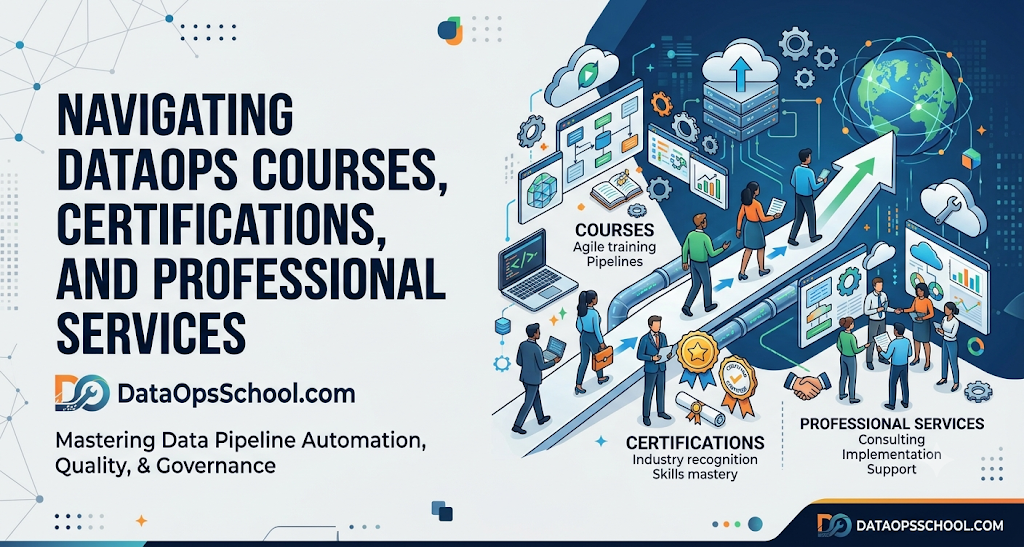
Introduction
Modern organizations rely on fast, accurate, and accessible data to drive operations, customer experiences, and strategic decisions. Yet, as data volumes grow and data architectures expand across multi-cloud environments, keeping data pipelines stable has become increasingly difficult. Traditional data management approaches often struggle under the weight of manual processes, siloed teams, changing schemas, and recurring quality failures.
To solve these operational bottlenecks, engineering teams turn to DataOps—a collaborative, automated approach that brings modern software engineering discipline to data analytics and engineering. Whether you are looking to streamline your internal data workflows or advance your career through professional learning platforms like DataOpsSchool.com, understanding DataOps is essential for building scalable, reliable data platforms.
What is DataOps?
At its core, DataOps is an operational framework that combines data engineering, automation, testing, collaboration, continuous integration, continuous delivery, monitoring, governance, and reliability practices.
DataOps is not a single software tool you can purchase and install. Instead, it represents a cultural and technical shift in how teams design, build, test, deploy, and monitor data systems. By integrating agile methodologies, DevOps principles, and statistical process control into data pipelines, DataOps reduces cycle times, minimizes errors, and bridges the gap between data producers, data engineers, and business consumers.
Why DataOps Matters
Organizations adopt DataOps to address the fundamental friction points of traditional data management. Without a structured operational framework, data teams frequently spend more time troubleshooting broken pipelines and fixing corrupted datasets than delivering business value.
Key benefits of adopting a DataOps approach include:
- Accelerated Data Delivery: Streamlining workflows enables faster deployment of new data sources, transformations, and dashboards.
- Enhanced Data Reliability: Continuous testing and automated validation catch anomalies before they impact downstream users.
- Reduced Manual Effort: Automating repetitive deployment and orchestration tasks frees engineers to focus on high-impact architecture.
- Improved Collaboration: Breaking down silos between data engineers, analytics teams, and operations staff fosters shared accountability.
- Greater Operational Visibility: Comprehensive monitoring and observability ensure teams have clear insight into pipeline health and performance.
Core DataOps Principles
DataOps builds upon several foundational principles derived from agile software development, DevOps, and lean manufacturing:
- Automation: Automating everything from infrastructure provisioning and code deployment to data testing and pipeline scheduling.
- Collaboration: Creating shared responsibility and transparent workflows across multi-disciplinary data teams.
- Continuous Integration and Delivery (CI/CD): Testing and deploying data pipelines incrementally and repeatably.
- Quality Assurance: Treating data quality as a continuous priority through automated validation, schema checks, and testing.
- Observability and Monitoring: Maintaining active tracking of data freshness, volume, distribution, and lineage.
- Reproducibility: Ensuring environments, dependencies, and transformations can be reliably recreated across development, staging, and production.
DataOps Lifecycle
A successful DataOps implementation follows a structured, iterative lifecycle that moves code and data seamlessly from concept to production:
Plan → Develop → Integrate → Test → Validate → Deploy → Monitor → Improve
- Plan: Define requirements, data contracts, and pipeline objectives in collaboration with stakeholders.
- Develop: Write modular transformation code, define schemas, and configure orchestration workflows.
- Integrate: Merge code changes into version control repositories to trigger automated build processes.
- Test: Execute unit tests, integration tests, and static code analysis.
- Validate: Run automated data quality checks against sample and production datasets.
- Deploy: Automatically promote validated pipelines to staging and production environments.
- Monitor: Track pipeline execution metrics, resource utilization, and data drift in real time.
- Improve: Analyze failures, optimize performance, and refine operational standards.
DataOps and Data Engineering
DataOps does not replace data engineering; rather, it elevates it. Data engineering focuses on building the infrastructure, extraction scripts, transformation logic, and loading mechanisms (ETL/ELT) that move data from source systems to analytical storage.
DataOps introduces operational rigor to these data engineering workflows. By applying version control to ETL code, automating unit tests for transformations, and establishing continuous monitoring for data lakes and warehouses, DataOps ensures that data engineering outputs remain robust, dependable, and easy to maintain over time.
DataOps and DevOps
While both frameworks share common roots in automation and CI/CD, they serve distinct operational domains within modern technology organizations.
| Area | DataOps | DevOps |
| Primary Focus | Data delivery and operations | Software delivery and operations |
| Pipelines | Data pipelines and analytical workflows | Application delivery and microservices |
| Quality | Data quality, accuracy, and schema validity | Code quality and application performance |
| Testing | Data testing, lineage validation, and anomaly checks | Application unit, integration, and security testing |
| Monitoring | Data pipelines, freshness, and data systems | Applications, infrastructure, and clusters |
| Collaboration | Data engineers, analysts, and governance teams | Software developers and operations teams |
Many modern enterprises implement both practices concurrently, utilizing DevOps for core application microservices and DataOps for analytical and data-intensive workloads.
DataOps Tools
DataOps relies on an ecosystem of specialized tools categorized by their function within the data lifecycle:
- Orchestration: Tools that manage pipeline dependencies, scheduling, and execution sequences.
- Version Control & CI/CD: Systems for tracking code changes, managing branches, and automating build/deployment pipelines.
- Data Testing & Quality: Frameworks designed to validate schemas, check row counts, and enforce data assertions.
- Data Observability: Solutions that monitor pipeline health, detect anomalies, track data lineage, and alert engineers to failures.
- Infrastructure as Code (IaC): Utilities used to provision cloud data warehouses, storage buckets, and compute clusters repeatably.
DataOps Automation
Automation sits at the heart of any mature DataOps practice. Manual script execution and ad-hoc deployments introduce human error and slow down delivery cycles.
Effective DataOps automation covers pipeline scheduling, infrastructure provisioning via code, automated testing suites, continuous deployment triggers, and intelligent alerting mechanisms. When implemented correctly, automation reduces toil while maintaining strict quality gates and audit trails.
Data Quality and DataOps
Data quality issues—such as missing values, unexpected schema changes, duplicate records, or delayed ingestion—can severely undermine business trust in analytics. DataOps treats data quality as a continuous, automated engineering discipline rather than a reactive cleanup task.
By embedding automated validation checks directly into CI/CD pipelines and production monitoring workflows, teams can catch corrupt data before it reaches dashboards, machine learning models, or executive reports.
Data Observability and Monitoring
Basic pipeline monitoring tells an engineer whether a job succeeded or failed. Data observability goes a step further by answering why a failure occurred and tracking subtle shifts in data health over time.
Modern data observability monitors several key pillars:
- Freshness: Ensuring data arrives on schedule.
- Volume: Detecting unexpected spikes or drops in record counts.
- Schema: Identifying unauthorized or breaking column modifications.
- Lineage: Mapping upstream and downstream dependencies across complex data ecosystems.
CI/CD for Data
Applying Continuous Integration and Continuous Delivery to data systems introduces unique technical challenges compared to traditional software. Data pipelines are stateful, rely heavily on underlying data volumes, and must account for complex schema evolution.
A robust data CI/CD workflow incorporates isolated development environments, automated schema migration testing, reproducible test datasets, and automated rollback strategies to ensure zero-downtime pipeline upgrades.
DataOps Training
As organizations increasingly demand reliable data operations, structured DataOps Training has become essential for technical professionals. A comprehensive training program bridges the gap between theoretical knowledge and practical engineering execution.
Effective training covers data architecture fundamentals, workflow orchestration, automated testing methodologies, CI/CD pipeline configuration, observability implementation, and cloud platform integration. Engaging with structured learning resources allows professionals to master modern operational standards efficiently.
DataOps Course and DataOps Tutorial
For learners seeking a guided path, a well-structured DataOps Course or hands-on DataOps Tutorial offers a progressive learning curve.
A standard educational roadmap typically follows this progression:
- Mastering DataOps fundamentals and core principles
- Designing and building reliable data pipelines
- Implementing workflow automation and orchestration
- Writing automated data tests and quality checks
- Configuring CI/CD pipelines for analytics code
- Setting up comprehensive observability and monitoring
- Scaling operations across cloud data platforms
DataOps Certification
Earning a DataOps Certification provides structured validation of an individual’s knowledge, technical proficiency, and commitment to industry best practices. Certification programs help professionals demonstrate their ability to design, automate, and maintain resilient data operations.
While certification validates foundational expertise, it is most valuable when combined with hands-on project experience and real-world implementation practice.
Certified DataOps Engineer
A Certified DataOps Engineer possesses the specialized technical skills required to build, test, automate, and maintain modern data pipelines.
Key competencies for this role include:
- Developing modular ETL/ELT transformation code
- Configuring robust workflow orchestration tools
- Implementing automated data quality testing suites
- Building CI/CD pipelines for data applications
- Setting up monitoring, logging, and alerting systems
- Troubleshooting pipeline performance bottlenecks and failures
Certified DataOps Architect
A Certified DataOps Architect focuses on high-level platform design, organizational strategy, and scalable infrastructure standards.
Architects are responsible for:
- Designing enterprise-grade data platform architectures
- Establishing governance frameworks and security standards
- Defining organizational automation and CI/CD policies
- Ensuring cross-system scalability, reliability, and cost-efficiency
- Guiding teams through multi-cloud and hybrid data modernization initiatives
DataOps Consulting
Organizations navigating digital transformation or struggling with unreliable data pipelines often benefit from professional DataOps Consulting.
Expert consultants evaluate existing architectures, identify operational bottlenecks, review CI/CD maturity, assess data quality practices, and deliver tailored implementation roadmaps. Effective consulting focuses on aligning technical improvements with measurable business objectives.
DataOps Services
Enterprise DataOps Services encompass a wide range of professional capabilities designed to accelerate data platform maturity. These services typically include end-to-end pipeline automation, data quality framework implementation, observability setup, cloud data platform migration, and ongoing operational optimization.
DataOps in the Cloud
Cloud computing provides the scalable compute and storage required for modern data operations. Cloud data warehouses, data lakes, and lakehouse architectures offer native support for elastic scaling, infrastructure as code, and managed orchestration.
Integrating DataOps practices with cloud data platforms enables organizations to dynamically provision environments, run isolated staging tests, and scale processing power on demand.
Common DataOps Challenges
Implementing DataOps across an enterprise is not without hurdles. Common challenges include:
- Legacy Monoliths: Retaining brittle, tightly-coupled legacy ETL scripts that resist automation.
- Cultural Resistance: Overcoming siloed communication between software development, data engineering, and business teams.
- Tool Fragmentation: Adopting too many disconnected tools without a cohesive architectural strategy.
- Skill Gaps: Training teams in modern CI/CD, automation, and observability practices.
Organizations can mitigate these challenges by adopting incremental implementation strategies and focusing on cultural collaboration alongside technical tooling.
DataOps Career and Learning Roadmap
Developing expertise in DataOps requires a deliberate, step-by-step approach:
- Learn foundational data engineering and SQL concepts.
- Understand core DataOps principles, agile workflows, and collaboration models.
- Gain proficiency in version control and CI/CD automation.
- Build expertise in automated data testing and quality frameworks.
- Master workflow orchestration and scheduling tools.
- Implement monitoring and data observability solutions.
- Explore cloud data platforms and infrastructure automation.
- Pursue professional certification to validate your skills.
How DataOpsSchool Supports DataOps Learning and Implementation
Mastering modern data operations requires reliable educational resources, structured guidance, and practical frameworks. DataOpsSchool.com serves as a specialized platform designed to support individuals and enterprises on their DataOps journey.
Through comprehensive training programs, practical courses, technical tutorials, and professional consulting services, DataOpsSchool helps professionals build career-ready competencies while enabling organizations to optimize their data reliability, automation, and governance practices.
DataOps Implementation Framework
Successfully implementing DataOps within an enterprise requires a structured, phased framework:
Assess → Define Goals → Design Architecture → Select Tools → Automate → Test → Deploy → Observe → Govern → Optimize
Organizations should begin by assessing their current pipeline maturity and defining clear reliability targets. From there, teams can incrementally introduce automation, testing, and observability without disrupting ongoing business operations.
FAQ Section
- What is DataOps? DataOps is an automated, collaborative methodology that applies agile and DevOps principles to data engineering and analytics to improve the velocity, quality, and reliability of data pipelines.
- What does DataOps training cover? Comprehensive DataOps training covers data pipeline design, workflow orchestration, automated testing, CI/CD implementation, data observability, governance, and cloud platform integration.
- What is a DataOps course? A DataOps course is a structured educational program designed to teach learners how to build, test, automate, and monitor data workflows using modern engineering practices and tools.
- Is DataOps certification useful? Yes, earning a certification provides formal validation of your knowledge and technical skills in data operations, helping you demonstrate proficiency to employers and peers.
- What skills are needed for a DataOps Engineer? A DataOps Engineer needs skills in ETL/ELT pipeline development, workflow orchestration, version control, CI/CD configuration, automated testing, and cloud data platforms.
- What does a DataOps Architect do? A DataOps Architect designs scalable enterprise data platforms, establishes governance and security standards, and defines organizational automation and infrastructure strategies.
- What are DataOps tools? DataOps tools include workflow orchestrators, version control systems, CI/CD platforms, automated data quality testing frameworks, and data observability solutions.
- How does DataOps differ from DevOps? While both focus on automation and delivery, DevOps centers on software applications and infrastructure, whereas DataOps specifically focuses on data pipelines, analytics, and data quality.
- What does DataOps consulting involve? DataOps consulting involves assessing an organization’s current data pipelines, reviewing architecture and CI/CD maturity, and providing implementation strategies to improve reliability and speed.
- How can organizations implement DataOps? Organizations can implement DataOps by assessing current workflows, introducing version control and automated testing incrementally, fostering team collaboration, and establishing continuous monitoring.
Conclusion
DataOps represents a vital evolution in how modern organizations manage and deliver data. By combining data engineering with automation, continuous testing, CI/CD, and robust observability, teams can eliminate operational friction and deliver dependable, high-quality data at scale.
Whether you are an engineer looking to enhance your technical capabilities, an architect designing enterprise platforms, or an organization seeking expert guidance, embracing DataOps principles is key to unlocking long-term data reliability. Explore professional learning paths, courses, and resources at DataOpsSchool.com to start building your DataOps expertise today.
