Introduction
Every time a mobile phone connects to a cellular tower, a quiet digital handshake takes place. Whether a smartphone is roaming in a foreign airport, an Internet of Things (IoT) sensor is transmitting telemetry from a shipping container, or a local subscriber is sending a text message across town, cellular networks must know who owns the infrastructure and which subscriber belongs where.
These complex connections do not happen by chance. Behind the commercial logos displayed on your phone’s screen lies an organized global numbering system managed under international telecommunications standards. For network engineers, software developers, IoT fleet managers, and international travelers, understanding how these identifiers work is the first step toward diagnosing connectivity issues, routing traffic properly, and verifying carrier records.
A standard MCC MNC Lookup allows engineers and researchers to decipher these numeric pairs, mapping raw cellular signal metadata back to the official entity authorized to broadcast that signal. Navigating these systems requires understanding how international numbering plans function, how codes map to real-world infrastructure, and where to find verified telecommunications provider data.
The Anatomy of Cellular Identification
Cellular identification relies on standardized numbering plans defined by the International Telecommunication Union Telecommunication Standardization Sector (ITU-T). The core standard governing mobile device and network identification is ITU Recommendation E.212.
Recommendation E.212 defines a unique identification plan for mobile terminals and mobile networks worldwide. The most prominent network-level identifier derived from this plan is the Public Land Mobile Network (PLMN) identity.
+-------------------------------------------------------------------+
|               International Mobile Subscriber Identity (IMSI)     |
+------------------------------------+------------------------------+
|   PLMN Identity (5 or 6 digits)    |                              |
+------------------+-----------------+  Mobile Subscription         |
| Mobile Country   | Mobile Network  |  Identification Number       |
| Code (MCC)       | Code (MNC)      |  (MSIN)                      |
| (3 digits)       | (2 or 3 digits) |                              |
+------------------+-----------------+------------------------------+
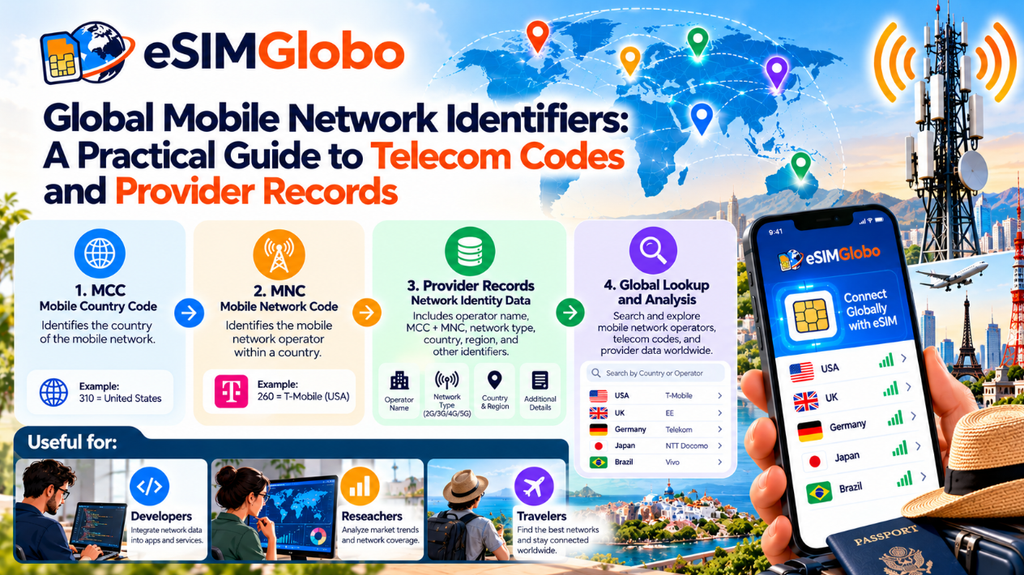
Every cellular network operating commercial or private radio access possesses a PLMN identity. A PLMN code consists of two distinct components: the Mobile Country Code (MCC) and the Mobile Network Code (MNC).
Mobile Country Codes (MCC)
The Mobile Country Code consists of three decimal digits. Its primary role is to identify a country, a specific geographic territory, or a global international network arrangement. For example:
310,311, and312map to the United States.404and405map to India.234and235map to the United Kingdom.901is reserved by the ITU for international shared networks, such as maritime satellite services or specialized cross-border IoT deployments.
It is worth noting that an MCC is not identical to an E.164 country calling code (such as +1 for North America or +44 for the UK). Calling codes route international voice calls through telephone switches, whereas MCC values route mobile data, subscriber authentication sessions, and signaling messages across cellular cores.
Mobile Network Codes (MNC)
The Mobile Network Code follows the MCC and consists of either two or three decimal digits. The MNC identifies the specific mobile network operator or authorized administrative network within the area covered by the MCC.
In Europe and much of Asia, two-digit MNC formats are standard, though three-digit codes also exist. In North America (under the North American Numbering Plan), three-digit MNC formats are standard. For instance, in the United States, code combination 310-410 historically identifies AT&T Mobility, where 310 is the MCC and 410 is the MNC. In Germany, 262-01 identifies Telekom Deutschland, using a two-digit MNC.
How PLMN Identifiers Function in Daily Connectivity
When an MCC and MNC are concatenated, they form a single five- or six-digit string known as the PLMN ID. For example, combining MCC 208 (France) with MNC 01 (Orange) produces the PLMN identity 20801.
Performing a reliable PLMN Code Lookup is critical when diagnosing SIM provisioning errors or configuring private enterprise LTE/5G setups. When a mobile device turns on its radio, it scans the airwaves for broadcasted system information blocks (SIBs). The cellular tower continually broadcasts its PLMN identity.
The SIM card inside the device contains an International Mobile Subscriber Identity (IMSI). The first five or six digits of that IMSI match the home PLMN of the issuing carrier. If the PLMN broadcast by the tower matches the SIM’s home PLMN, the device registers directly. If the codes differ, the device initiates a roaming handshake, querying whether a wholesale agreement permits the visitor to access that tower.
Connecting Numbers to Real Organizations
Raw numeric codes are essential for machine signaling, but humans and software applications need to translate those numbers into recognizable entities. Connecting an abstract identifier to a registered corporation requires structured, well-maintained references.
A comprehensive Mobile Network Operator Directory bridges the gap between raw cellular codes and corporate entities. Such directories map numeric assignments to the registered operating company, its official brand names, and the licensing regulator that assigned the spectrum.
Connecting a code with an operator involves several verification steps:
- Signal Interception or Metadata Extraction: A network monitor or application reads the broadcasted PLMN (e.g.,
505-01). - Identifier Parsing: The system splits the code into its country component (
505) and network component (01). - Database Cross-Referencing: The system searches a catalog of operator records to find the registered assignee (in this case, Telstra in Australia).
- Scope Verification: The researcher checks whether the assignment is national, regional, or reserved for testing and military use.
However, researchers must note that an entry in an official registry does not guarantee that a live cellular signal is currently available at any given geographic coordinate. Regulators frequently assign codes for planned network deployments, internal network isolation, test environments, or regional rail signaling (such as GSM-R).
Furthermore, historical assignments can remain in reference databases long after an older 2G or 3G network has been shut down or consolidated through corporate buyouts. Independent platforms like eSIMGlobo organize these records by cross-referencing ITU documentation with national regulatory notices to help researchers clarify the active status of registered assignees.
Geographic Distribution of Mobile Network Identifiers
Telecommunications numbering plans are inherently geographic, though regional nuances often complicate simple country-by-country categorization.
+-------------------------------------------------------------+
|               Global Geographic Regions (ITU)               |
+-------------------------------------------------------------+
| Region 2: Europe                 | MCCs starting with 2     |
| Region 3: North America          | MCCs starting with 3     |
| Region 4: Asia                   | MCCs starting with 4     |
| Region 5: Oceania & Australasia  | MCCs starting with 5     |
| Region 6: Africa                 | MCCs starting with 6     |
| Region 7: South & Central America| MCCs starting with 7     |
| Region 9: International Networks | MCCs starting with 9     |
+-------------------------------------------------------------+
When analyzing mobile networks on an international scale, consulting a Global Telecom Provider Directory allows enterprise analysts to understand which groups manage critical connectivity assets across borders.
Regional Numbering Allocations
The ITU assigns MCC ranges based on world zones. For example:
- Codes beginning with
2cover Europe. - Codes beginning with
3cover North America and parts of the Caribbean. - Codes beginning with
4cover Asia and the Middle East. - Codes beginning with
5cover Oceania and Australasia. - Codes beginning with
6cover Africa. - Codes beginning with
7cover Central and South America.
Reviewing structured catalogs of Mobile Network Codes by Country helps developers build country-aware applications. For example, a multi-country logistics platform tracking connected vehicles can correlate carrier transitions as freight crosses international borders.
Edge Cases and Non-Standard Territorials
Not every MCC corresponds cleanly to a sovereign, recognized nation-state. Specialized assignments exist for:
- Overseas Territories: Island dependencies often have distinct MCC assignments despite sharing political sovereignty with a mainland government. For example, Puerto Rico uses MCC
330, distinct from the mainland US codes310–312. - Shared International Operations: An MCC like
901belongs to no single country. Instead, the ITU assigns MNCs under901directly to trans-national satellite operators, airborne mobile networks, and enterprise IoT platforms operating outside standard domestic frameworks. - Antarctica and Remote Regions: Remote scientific outposts often route cellular infrastructure through international satellite links or temporary field assignments, creating atypical directory entries.
A structured Mobile Country Code List helps systems normalize these geographic exceptions. Rather than assuming every SIM card belongs to a traditional country, reference directories classify entries by administrative status, regulatory authority, and geographic operational scope.
Operators, Virtual Carriers, and Retail Brands
One of the most common points of confusion in telecommunications research is the distinction between who owns the physical network infrastructure and who sells the consumer subscription.
The entity listed on an official regulatory document is often different from the commercial brand displayed on a store shelf or web application.
+-------------------------------------------------------------+
|             Mobile Network Operator (MNO)                   |
|   - Owns cellular towers, antennas, base stations           |
|   - Holds licensed radio spectrum                           |
|   - Owns core network hardware (HSS, UDM, UPF)              |
|   - Holds official MCC/MNC allocation from national body    |
+-------------------------------------------------------------+
                              |
                     Wholesale Agreement
                              |
                              v
+-------------------------------------------------------------+
|          Mobile Virtual Network Operator (MVNO)             |
|   - Does not own radio transmission towers                  |
|   - Purchases wholesale network capacity                    |
|   - Issues custom SIMs or uses host carrier profiles        |
|   - Manages retail billing, customer support, and plans     |
+-------------------------------------------------------------+
Mobile Network Operators (MNOs)
A Mobile Network Operator is an infrastructure-owning telecommunications provider. MNOs hold licensed radio spectrum granted by a national communications authority (such as the FCC in the United States, Ofcom in the United Kingdom, or BNetzA in Germany).
MNOs own, construct, and maintain the physical towers, antennas, base stations, fiber backhaul, and switching centers required to broadcast wireless signals. In almost all jurisdictions, official national regulators assign MCC and MNC values directly to licensed MNOs.
Mobile Virtual Network Operators (MVNOs)
A Mobile Virtual Network Operator provides mobile voice and data services to subscribers without owning the physical radio access network (RAN). Instead, MVNOs negotiate wholesale agreements with host MNOs to transmit traffic across the host’s existing cellular towers.
Consulting a curated MVNO Directory helps illustrate the varied technical integrations used across the virtual connectivity market:
- Full MVNOs: These organizations operate their own core switching systems, home subscriber servers, and gateway packet nodes. Full MVNOs often apply for their own distinct MNC assignment from the national regulator, issuing proprietary SIM cards with their own unique PLMN identity.
- Light or Thin MVNOs: These providers act primarily as marketing, packaging, and billing layers. They rely entirely on their host carrier’s technical core and issue SIM cards that broadcast the host MNO’s PLMN identity. In this scenario, an MCC/MNC query will return the name of the infrastructure owner, not the retail brand on the customer’s invoice.
Understanding these structural differences prevents organizations from misinterpreting network traces during audits, vendor assessments, or security evaluations.
Structuring Telecom Operator Intelligence
Telecommunications registries are not static documents. Regulatory assignments evolve as corporate entities merge, spectrum licenses are auctioned, network technologies are decommissioned, and new market entrants receive testing allocations.
| Field Name | Description | Example Record |
| MCC | 3-digit Mobile Country Code | 234 |
| MNC | 2- or 3-digit Mobile Network Code | 15 |
| PLMN Identity | Combined numerical identifier | 23415 |
| Country / Territory | Geographic allocation reference | United Kingdom |
| Operating Company | Officially assigned corporate entity | Vodafone UK |
| Brand / Trading Name | Market-facing consumer brand | Vodafone |
| Assignment Status | Regulatory licensing state | Active / Allocated |
| Primary Reference | Official administrative source | ITU-T E.212 / Ofcom |
A well-architected Telecom Operator Database requires continuous curation and verification. Ensuring data integrity involves:
- Standardized Formatting: Enforcing consistent digit counts across variable-length MNCs (e.g., storing
01with its leading zero rather than simplifying it to integer1). - Transparent Sourcing: Linking records directly to official bodies, such as the ITU’s operational bulletins or national regulatory gazettes.
- Change Tracking: Recording corporate acquisitions, license revocations, and network consolidation events over time.
- Disambiguation: Distinguishing regional spectrum holders that share an MNC across non-overlapping domestic markets.
eSIMGlobo emphasizes structured data hygiene by pairing operator records with documented sources and verification statuses. Rather than treating operator lists as unalterable truths, the directory highlights the origin and administrative history of each record.
Researching Consumer Connectivity and the eSIM Ecosystem
The rise of embedded SIM (eSIM) and integrated SIM (iSIM) technologies has transformed how consumers and enterprises purchase cellular connectivity. Rather than buying a physical plastic chip from a local retail store, users can download an encrypted digital subscriber profile over the air (OTA).
This shift has created a large ecosystem of travel connectivity brokers, roaming aggregators, and digital storefronts. However, researching modern digital connectivity requires distinguishing between infrastructure operators and retail profile retailers.
A dedicated eSIM Provider Directory allows enterprise procurement teams and international travelers to evaluate connectivity vendors based on concrete service metrics:
- Underlying Network Partnerships: Which host MNOs provide the actual radio access in destination countries?
- Supported Destination Footprints: Does the service include cross-border regional packages or single-country profiles?
- Profile Capabilities: Does the profile include a local phone number with voice channels, or is it a data-only roaming profile routed through an international breakout server?
- Latency and Breakout Routing: Where is the data gateway located? An eSIM profile purchased for use in Japan that routes traffic through a gateway in Europe will suffer noticeable latency delays.
It is essential to separate a registry of physical network identifiers from a directory of commercial eSIM sellers. The former documents regulatory radio assignments; the latter documents commercial software profiles sold to travelers and IoT integrators.
While eSIMGlobo focuses primarily on verified network operator records and official identifier lookups, its long-term roadmap includes dedicated directories for commercial MVNOs and eSIM providers as verified data sets become available.
Engineering Workflows and Technical Applications
Network code intelligence is essential for automated telecommunications software. Developers, systems architects, and data engineers rely on clean carrier records to power a wide range of production applications:
+-------------------------------------------------------------+
|                Inbound Cellular Telemetry                   |
|                (MCC: 204, MNC: 04, LAC, CellID)             |
+-------------------------------------------------------------+
                              |
                              v
+-------------------------------------------------------------+
|            Automated Data Enrichment Pipeline               |
|   - Queries operator reference database                     |
|   - Resolves country: Netherlands                           |
|   - Resolves carrier: Vodafone Libertel B.V.                |
|   - Validates roaming status against whitelist              |
+-------------------------------------------------------------+
                              |
                              v
+-------------------------------------------------------------+
|                 Enterprise Business Logic                   |
|   - IoT Asset Tracking: Verifies permitted operating zone   |
|   - Fraud Prevention: Flags anomalous SIM origin            |
|   - Telecom Billing: Confirms wholesale rating tier         |
+-------------------------------------------------------------+
Common Engineering Use Cases
- Fraud Detection and Risk Modeling: Financial fraud systems inspect the issuing carrier of an SMS authentication recipient. If a one-time passcode is routed to an unallocated or high-risk test MNC, the transaction can be flagged for automated review.
- IoT Fleets and Asset Tracking: Connected logistics devices continuously report cellular environment scans. Asset tracking engines cross-reference MCC and MNC values against route boundaries to confirm that cargo remains along authorized transport corridors.
- Network Testing and QA: Quality assurance teams testing mobile apps inspect cellular parameters to simulate diverse bandwidth constraints, geographic routing paths, and carrier-specific CDN nodes.
- Telecom Data Enrichment: Customer relationship management (CRM) and analytics platforms enrich raw telecom identifiers with verified corporate information to enhance reporting accuracy.
Programmatic Integration Needs
As enterprises scale these data pipelines, manual record queries become impractical. While researchers currently use web-based directories for single-record lookups, technical roadmaps across the telecommunications intelligence sector prioritize automated access.
An MCC MNC Lookup API serves as a core architectural goal for platforms building automated telecom infrastructure. Integrating an API enables applications to query carrier records, check operator verification statuses, and retrieve numbering plan changes in real time.
For platforms like eSIMGlobo, programmatic interfaces represent an intuitive evolution of their existing directory architecture, providing developers with reliable, structured access to validated network assignment data.
Practical Checklist for Verifying Telecom Records
When conducting telecom research, working with unverified or outdated lists can lead to misconfigured devices and flawed analyses. Use this verification checklist before relying on an identifier record:
- Verify the Official Regulatory Gazette: Cross-check the assignment against national frequency management records (e.g., ITU-T Operational Bulletins or domestic agency databases).
- Confirm Code Formatting: Ensure that leading zeros in two-digit and three-digit MNCs are preserved (e.g., distinguishing between MNC
02and MNC20). - Check the Assignment Date: Review when the record was last validated. Look for corporate mergers, spectrum transfers, or operator bankruptcies that occurred after the initial filing.
- Separate Brand from Assignee: Determine whether the listed entity is the infrastructure owner, an operating subsidiary, or an independent retail brand.
- Inspect the Operational Scope: Verify whether the code is designated for commercial operation, emergency signaling, municipal rail operations, or temporary laboratory testing.
Frequently Asked Questions
What is the difference between an MCC and an MNC?
The Mobile Country Code (MCC) is a three-digit number that identifies a country, geographic region, or international shared network. The Mobile Network Code (MNC) is a two- or three-digit number that identifies the specific mobile network operator within that country or region.
Can two different mobile network operators share the same PLMN code?
In standard domestic cellular deployments, PLMN codes (the combined MCC and MNC) are uniquely allocated to prevent signal routing conflicts. However, infrastructure-sharing partnerships or national roaming agreements may allow multiple virtual brands or wholesale partners to broadcast the same underlying PLMN.
Are Mobile Country Codes the same as international phone calling codes?
No. Mobile Country Codes (MCCs) are defined by ITU-T Recommendation E.212 to identify cellular networks and route wireless data. Telephone calling codes (such as +1 or +44) are defined by ITU-T Recommendation E.164 to route standard voice calls across the global public switched telephone network (PSTN).
How long does an MNC assignment remain valid?
An MNC assignment remains valid until the national regulatory body revokes it, the operator returns the spectrum, or the company ceases operations. Some codes remain assigned for decades, while others change following corporate mergers, acquisitions, or restructuring.
Does having an active network code mean a carrier has nationwide coverage?
No. A code assignment represents an administrative authorization to operate a cellular network within an assigned territory. It does not measure physical tower density, radio spectrum reach, or commercial population coverage.
Why do some countries use both 2-digit and 3-digit MNCs?
Different telecommunications regions established their numbering architectures independently. Most European nations adopted two-digit MNCs, while North American systems adopted three-digit formats to accommodate a larger volume of regional operators. Some national regulatory plans now allow mixed allocations as spectrum demands grow.
Can an MVNO obtain its own official MCC/MNC assignment?
Yes, under specific conditions. A “Full MVNO” that operates its own core network switching equipment and home subscriber registers can apply to national regulators for a dedicated MNC. Smaller “Light MVNOs” typically use the network codes of their host infrastructure provider.
What causes a PLMN code to return an “Unknown Operator” result?
This generally occurs if the code is newly allocated by a regulator, assigned to a closed private LTE/5G network, reserved for internal testing, or entered with incorrect digit formatting (such as dropping a required leading zero).
Conclusion
Modern cellular connectivity relies on structured numbering frameworks that route data across borders, towers, and devices. Deciphering these underlying network codes is essential for telecom analysts, software developers, and connectivity professionals seeking to understand how mobile operators manage global infrastructure.
By systematically distinguishing between physical network operators and virtual service providers, verifying assignment sources against official standards like ITU Recommendation E.212, and understanding the role of geographic allocations, researchers can analyze cellular data with precision.
Independent directories like eSIMGlobo.com help make this complex data accessible by organizing verified operator records, tracking assignment histories, and offering clear lookup tools for mobile network codes worldwide. As digital networks continue to expand, relying on validated, transparently sourced telecom data remains the foundation for building resilient, connected systems.
